

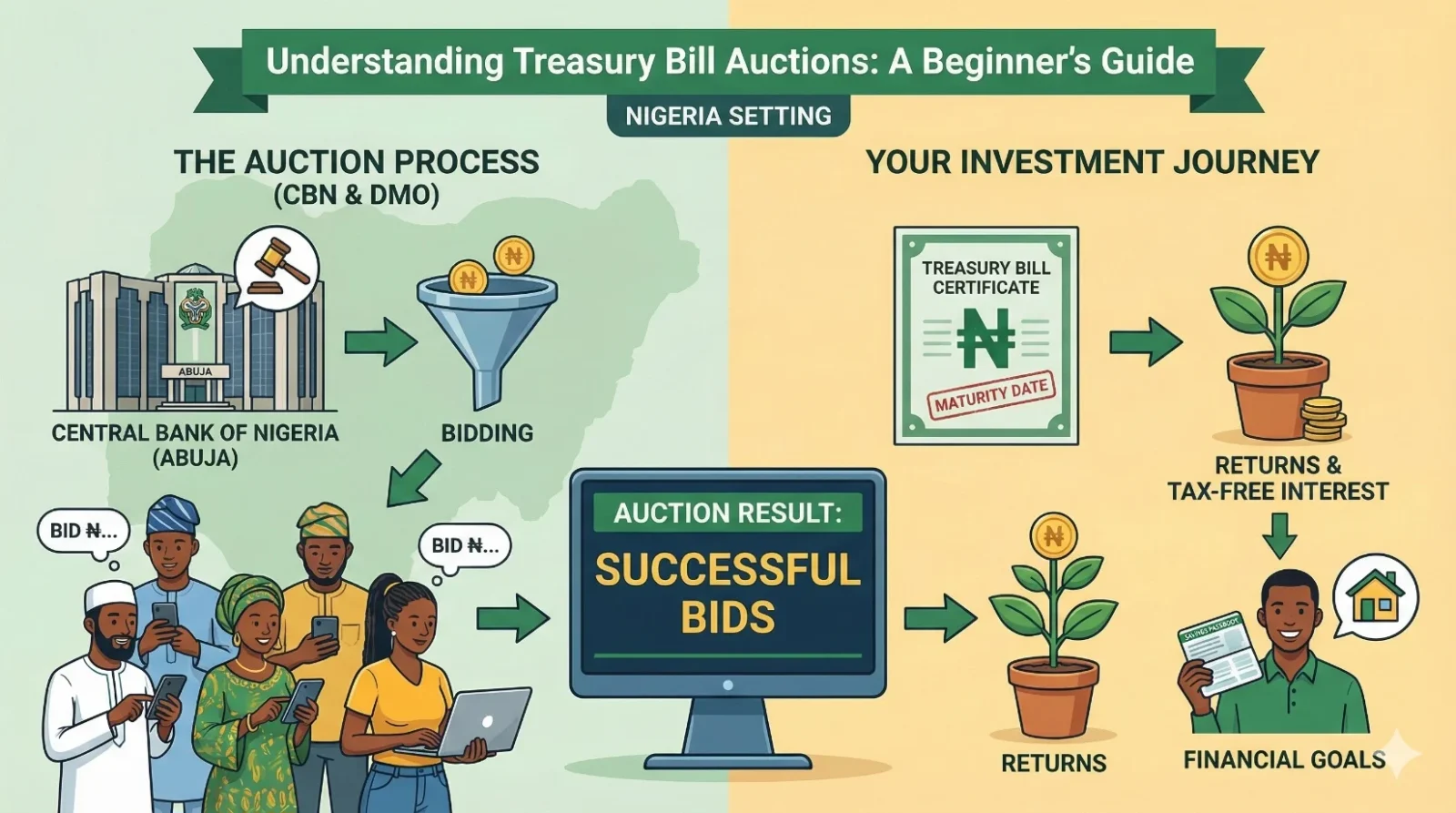
When a government needs to fund its operations or manage the national economy, it essentially borrows money from its citizens. In Nigeria, the Central Bank of Nigeria (CBN) facilitates this by issuing Treasury bills (T-bills). These are not merely pieces of paper; they are highly secure instruments that allow the public to lend money to the government for a short period. Read Why Investors are Snubbing the Middle Ground: Inside Nigeria’s Year-End Treasury Bill Surge.
Simple Definition: A Treasury bill is a short-term investment security issued by the government. When you buy one, you are lending money to the government for a specific duration. In return, the government pays you back your initial investment plus interest.
As an investment strategist, I view T-bills as essential investment securities that allow individuals to take strategic “positions” in the financial market. Because they are backed by the full faith and credit of the federal government, they are considered one of the safest places to grow your wealth. To navigate this market successfully, however, you must understand the “rules of the game” specifically, how the auction process functions.
2. Decoding the Auction Vocabulary
To participate in an auction, you must first master the terminology used by the CBN and professional traders. These four terms are the pillars of every auction result.
| Term | Plain-English Meaning |
| Tenor | The duration of the investment. CBN auctions typically feature three windows: 91-day, 182-day, and 364-day tenors. |
| Subscription | The total “demand.” This is the total amount of money investors offered to lend the government (e.g., the ₦1.509 trillion total demand in the December auction). |
| Allotment | The final amount the bank actually sold to investors. Note that the bank may reject some bids; for the 182-day bill, although investors offered ₦22.66 billion, the CBN only allotted ₦22.07 billion. |
| Spot Rate | The interest rate or “price” of the money. This is the annual percentage return you earn on your investment. |
Understanding these terms is the first step in analyzing the real-world results of the Central Bank’s December 2025 auction.
3. Case Study: Inside the Central Bank of Nigeria (CBN) December 2025 Auction
In mid-December 2025, the CBN conducted its final auction of the year, offering a total of ₦700 billion. The results showcased a clear divide in investor appetite across the three available maturities.
Auction Results Summary
| Tenor | Amount Offered | Amount Subscribed (Demand) | Amount Allotted | Final Spot Rate |
| 91-Day | ₦100 Billion | ₦100.63 Billion | ₦100.01 Billion | 15.50% |
| 182-Day | ₦100 Billion | ₦22.66 Billion | ₦22.07 Billion | 15.95% |
| 364-Day | ₦500 Billion | ₦1.385 Trillion | ₦581.99 Billion | 17.51% |
Subscription Success vs. Underperformance
The data reveals a “sustained appetite for duration.” Investors overwhelmingly favored the 364-day bills, where demand (₦1.385 trillion) was nearly triple the original ₦500 billion offer. Conversely, the 182-day bills significantly underperformed, failing to meet the ₦100 billion target.
Crucially, even when the 182-day bill was undersubscribed, the CBN did not accept every bid; they only allotted ₦22.07 billion of the ₦22.66 billion offered. This lack of interest forced the CBN to increase the interest rate to attract future buyers.
4. The “So What?”: Interpreting the Rates
As a new investor, you must watch the movement of the Spot Rate. These rates are often discussed in terms of basis points—a professional unit of measure where 100 basis points equal 1%. Therefore, a 20 basis point rise is a 0.20% increase.
- High Demand Gives the Government Leverage: Think of the government as a shopper looking for the lowest “price” (interest rate). When many people want to lend money—as seen with the 364-day bill—the CBN has the leverage to scale back or reduce the rate. Because demand was so high, they successfully lowered the rate from 17.95% to 17.51%.
- Rate Hikes are Used to Attract Interest: When an investment is unpopular, the government must offer a better deal. For the 182-day bill, the paltry demand led the authority to hike the rate by 45 basis points (0.45%) to 15.95%, signaling to the market that they are willing to pay more for your money.
- Short-Term Adjustments: For the 91-day bills, which saw healthy but stable demand, the CBN opted for a modest 20 basis point (0.20%) rise to 15.50%, ensuring the investment remains competitive with other short-term options.
Key Takeaway: The relationship is driven by supply and demand. High popularity (Subscription) allows the government to pay lower interest, while low popularity usually forces them to raise rates to lure investors back.
5. Summary and Encouragement
A Treasury bill auction is essentially a competitive marketplace where you are the lender and the government is the borrower. By setting an Offer, monitoring the Subscription, and deciding on the final Allotment and Spot Rate, the CBN balances its need for funds with the public’s desire for returns.
To stay informed for future auctions, keep this checklist handy:
Quick-Reference Checklist for Investors:
- Tenor: Is the duration (91, 182, or 364 days) appropriate for my financial goals?
- Subscription Level: Is there high demand? (High demand may lead to lower interest rates).
- Allotment: How much did the government actually sell compared to what was requested?
- Spot Rate: Is the rate moving up (a “hike”) or down (a “scale back”)?
Understanding these fundamentals is the first step toward becoming a confident investor. By monitoring these auction results, you can see exactly where the market is heading and ensure your money is working as hard as possible for you.






Leave a comment