

Accessing foreign exchange in Nigeria has long been a topic of intense public interest and frequent challenge. In a move set to fundamentally reshape the retail forex market, the Central Bank of Nigeria (CBN) has rolled out a major new regulatory framework for Bureau De Change (BDC) operators. An initial batch of 82 operators has been granted final licenses under these stricter rules, with an effective date of November 27, 2025. However, the full implications of this change from massive new fees to billion-naira capital requirements are more surprising and far-reaching than they might appear at first glance. Read on Understanding Nigeria’s New Currency Exchange Rules: Tier 1 vs. Tier 2 BDCs and Executive Summary: Financial and Operational Impact of New CBN BDC Licensing Framework.
Here are four key realities of the new BDC landscape.
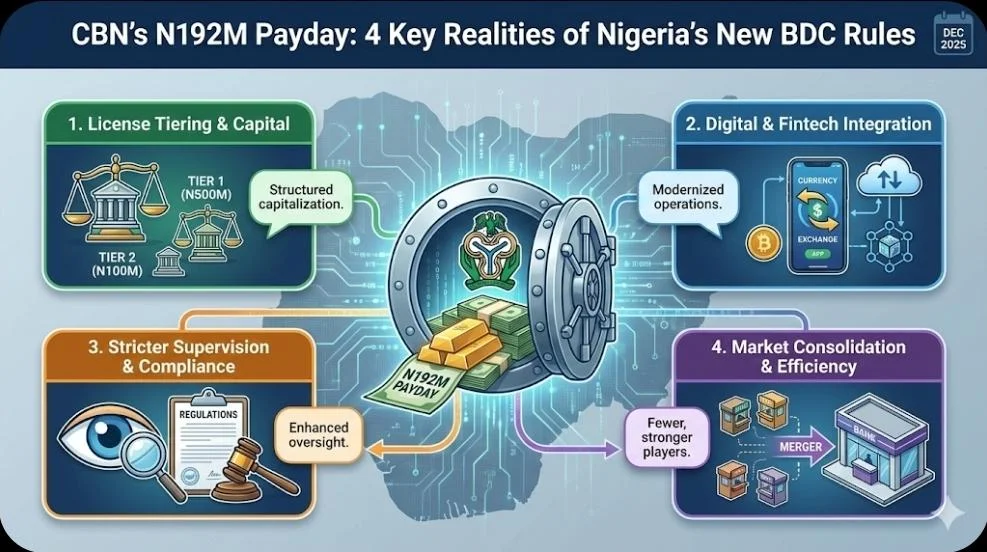
1. The N192 Million Fee Windfall
The most immediate and striking outcome of the new licensing round is the significant revenue generated for the Central Bank. From just the first 82 newly licensed BDCs, the CBN has already earned N192 million in non-refundable fees.
A granular analysis of the CBN’s fee schedule reveals precisely how this figure was calculated:
- The new framework establishes two BDC categories: Tier 1 and Tier 2.
- Tier 1 Operators (2 firms): Each paid a N1 million non-refundable application fee and a N5 million non-refundable licence fee.
- Calculation: 2 operators x (N1m + N5m) = N12 million.
- Tier 2 Operators (80 firms): Each paid a N250,000 non-refundable application fee and a N2 million non-refundable licence fee.
- Calculation: 80 operators x (N250,000 + N2m) = N180 million.
- Grand Total: N12 million (from Tier 1) + N180 million (from Tier 2) = N192 million.
This N192 million, collected from a mere fraction of potential operators, serves as a powerful statement of intent from the CBN. It establishes a new financial reality where participation in the forex market comes at a premium, immediately filtering out smaller entities before capital requirements are even considered.
2. The New Billion-Naira Barrier to Entry
While the N192 million in non-refundable fees is substantial, it is entirely separate from the massive new minimum capital requirements that now serve as the primary barrier to entry.
The new capital thresholds are:
- Tier 1 BDCs: Minimum capital of N2 billion.
- Tier 2 BDCs: Minimum capital of N500 million.
This isn’t merely an increase; it’s a strategic re-engineering of the sector. The shift from a fragmented market of many small-scale operators to an oligopoly of highly capitalized entities is now all but certain. The era of the neighborhood BDC is effectively over, replaced by a corporate-level forex system.
3. A New Hierarchy: The Tale of Two Tiers
The regulations don’t just raise the financial stakes; they also create a clear operational hierarchy within the BDC sector. The two tiers come with distinct scopes and limitations, formalizing the structure of the retail foreign exchange market.
- Tier 1 Operators: These firms are permitted to operate nationwide. They can open branches and appoint franchisees, subject to CBN approval. The first two licensed Tier 1 firms are Dula Global BDC Ltd and Trurate Global BDC Ltd.
- Tier 2 Operators: The operations of these firms are restricted to a single state (or the Federal Capital Territory). They are allowed to open a maximum of five branches within that state, also subject to CBN consent.
This bifurcation institutionalizes a power dynamic, creating a clear distinction between national players with broad influence and regional operators with a more limited footprint.
4. The Official Rationale: Beyond the Money
According to the CBN, the sweeping reforms are driven by a clear set of strategic objectives aimed at sanitizing the forex market and strengthening its integrity. The official purpose goes beyond revenue generation and focuses on creating a more stable and transparent system.
The CBN’s stated goals for the new framework include:
- To improve access to foreign exchange for retail users.
- To strengthen the financial sustainability of BDC operators.
- To curb money laundering and other illicit financial flows.
In a recent statement, the Central Bank underscored its commitment to ensuring compliance and protecting the public from unauthorized dealers.
“While the CBN will continue to update the list of Bureaux De Change with valid operating licences for public verification on our website, the Bank advises the general public to avoid dealing with unlicensed Foreign Exchange Operators,”
Conclusion
The new BDC regulations represent a profound and deliberate overhaul of Nigeria’s retail foreign exchange market. The immediate fee windfall for the CBN, coupled with towering new capital requirements and a formalized two-tier system, signals a clear strategic pivot. While the stated objective is to curb illicit financial flows and enhance stability, the practical outcome is a market consolidated in the hands of a few well-funded players.
As the dust settles, the architecture of this critical market has been irrevocably altered. The central question is no longer if the market will change, but whether this new, highly capitalized, and tightly controlled system can deliver on its promise of stability without sacrificing the accessibility that defined the previous era.







Leave a comment