

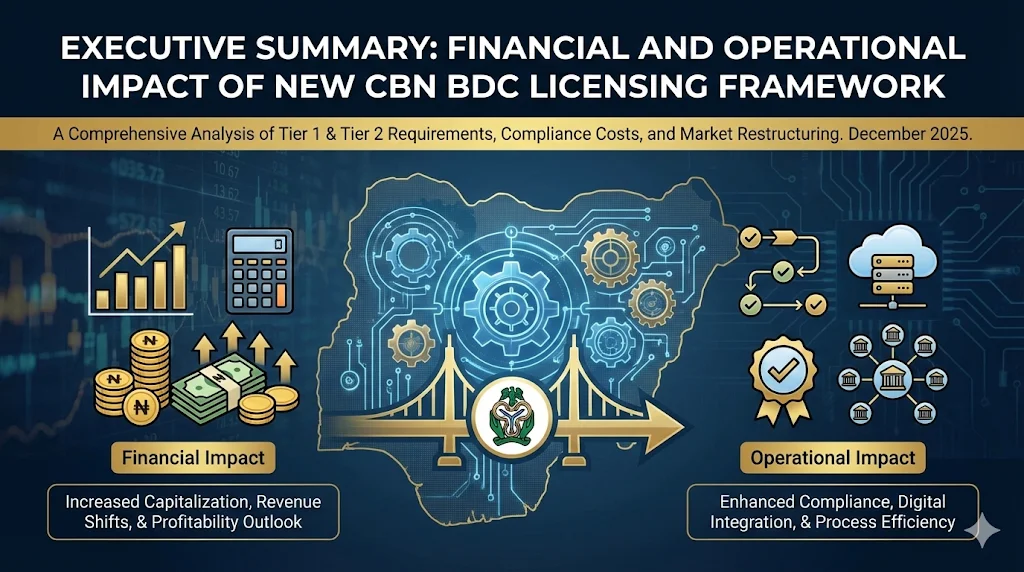
The Central Bank of Nigeria (CBN) has commenced a strategic overhaul of the Bureau De Change (BDC) sub-sector, licensing an initial cohort of 82 operators under its revised 2024 guidelines. The immediate financial outcome of this first phase, effective as of November 27, 2025, is the generation of N192 million in non-refundable application and licence fees. This summary provides an analysis of these financial results, details the new two-tier operational framework, and outlines the strategic objectives driving this comprehensive reform. Read on CBN’s N192M Payday: 4 Key Realities of Nigeria’s New BDC Rules.
2.0 Financial Impact: Analysis of Licence Fee Revenue
The initial N192 million in fee-based revenue serves as an early validation of the framework’s capacity to attract significant capital commitment from the market. This income stream, collected before operators commence business, underscores the financial commitment now required to participate in the formal retail foreign exchange market. The revenue is composed of payments from two distinct operator tiers.
A detailed breakdown of the total fees generated is as follows:
- Tier 1 Operators (2 firms): Total revenue of N12 million.
- Application Fees: N2 million (N1 million per operator)
- Licence Fees: N10 million (N5 million per operator)
- Tier 2 Operators (80 firms): Total revenue of N180 million.
- Application Fees: N20 million (N250,000 per operator)
- Licence Fees: N160 million (N2 million per operator)
These substantial financial prerequisites are directly linked to the distinct operational capacities and scopes defined within the CBN’s new two-tier BDC structure.
3.0 Analysis of the New Two-Tier Operational Framework
The new framework fundamentally reshapes the BDC landscape by creating two distinct tiers with significantly different operational capacities and capital requirements. This tiered system is designed to segment the market based on financial strength and intended scope of operations. Understanding this structure is critical for assessing future market competition, service delivery, and the overall effectiveness of the reforms.
The key distinctions between the two tiers are summarized below:
| Attribute | Tier 1 BDC | Tier 2 BDC |
| Minimum Capital Requirement | N2 billion | N500 million |
| Licence & Application Fees (Total) | N6 million (N1m Application + N5m Licence) | N2.25 million (N250k Application + N2m Licence) |
| Permitted Operational Scope | Nationwide | One state or the Federal Capital Territory |
| Branch & Franchise Network | Permitted to open branches and appoint franchisees nationwide, subject to CBN approval | Permitted to establish up to five branches within its state of operation, with CBN consent |
This tiered structure is not merely administrative; it is the core mechanism for achieving the CBN’s strategic objectives. The N2 billion capital requirement for Tier 1 operators directly addresses the goal of Strengthening Operator Viability for nationwide activities, while the distinct operational scopes are designed to Improve Foreign Exchange Access at both national and regional levels, thereby helping to formalize the market and Curb Illicit Financial Flows.
4.0 Core Strategic Objectives of the CBN Reforms
The CBN’s reforms represent a strategic intervention aimed at enhancing the stability, transparency, and integrity of the retail foreign exchange market. The new guidelines are not merely administrative; they are designed to address systemic vulnerabilities and align the BDC sub-sector with broader financial system objectives.
Based on official communications from the CBN, the core strategic goals of the new framework include:
- Improving Foreign Exchange Access: To enhance the availability of foreign exchange for retail users across the country through a more structured and reliable network of operators.
- Strengthening Operator Viability: To bolster the financial sustainability and operational capacity of BDC operators by enforcing significantly higher minimum capital requirements.
- Curbing Illicit Financial Flows: To mitigate the risks of money laundering, terrorism financing, and other illegal financial activities by professionalizing the sub-sector and improving regulatory oversight.
The successful implementation of these strategic pillars is now contingent on sustained regulatory oversight and the market’s adaptation to this new, more demanding operational landscape.
5.0 Conclusion and Market Outlook
The CBN’s new BDC licensing framework has successfully established a more robustly capitalized and structured retail foreign exchange sub-sector, generating N192 million in initial revenue. The reforms introduce a clear distinction between national and state-level operators, a move designed to enhance financial stability and combat illicit financial activities. The initial prevalence of Tier 2 licensees suggests a market preference for state-level operations, potentially reflecting a cautious, phased approach to the new capital-intensive environment.
The CBN will continue to update its list of approved operators, signaling an ongoing process of integrating more players who meet the stringent new requirements. This phased implementation underscores a long-term commitment to regulatory enforcement. The Bank has issued a clear warning to the public to engage only with BDCs officially licensed and listed on its website, reinforcing that operating without a valid licence is a prosecutable offence.







Leave a comment