

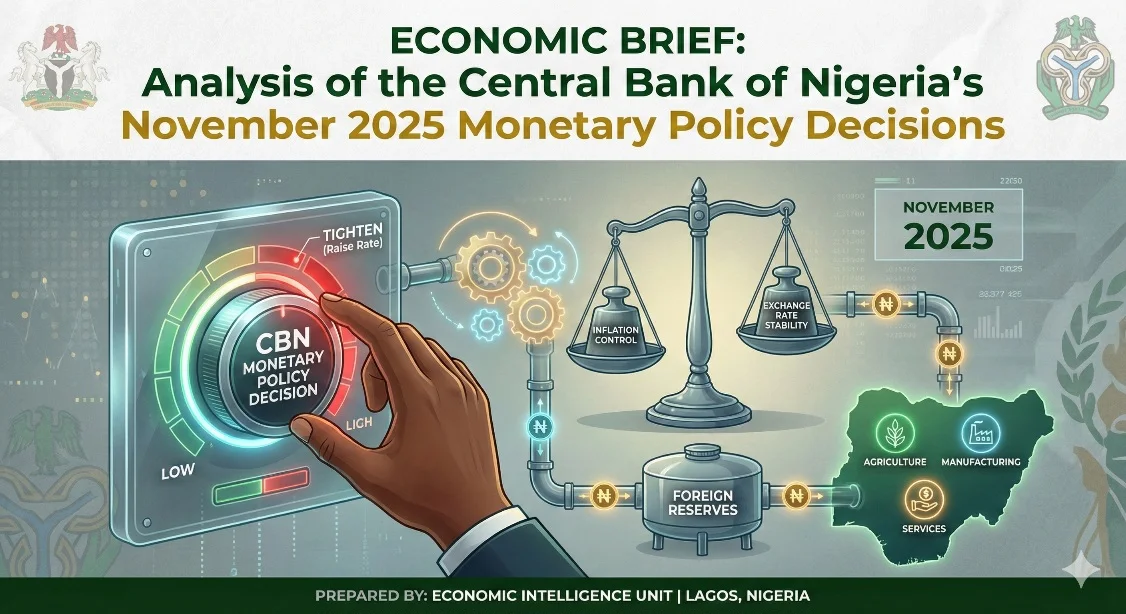
This brief provides an analysis of the key policy decisions and economic data reviewed by the Central Bank of Nigeria’s (CBN) Monetary Policy Committee (MPC) during its 303rd meeting, which concluded on November 25, 2025. It examines the rationale behind the committee’s actions and offers a summary of the forward-looking outlook for the Nigerian economy. Read on Understanding the Central Bank of Nigeria’s Latest Economic Decision (MPC Communique).
1. Monetary Policy Committee (MPC) Decisions
The decisions of the MPC are critical signals to domestic and international markets, reflecting the central bank’s stance on managing inflation, fostering economic growth, and ensuring financial stability. At its November 2025 meeting, the committee voted to maintain the existing monetary policy stance, signaling a focus on allowing previous tightening measures to take full effect.
The specific decisions reached by the committee are detailed below:
| Policy Instrument | Decision (November 2025) |
| Monetary Policy Rate (MPR) | Retained at 27.0% |
| Standing Facility Corridor | Adjusted to +50/-450 basis points around the MPR |
| Cash Reserve Requirement (CRR) | Retained at:<br>• 45.00% for Deposit Money Banks<br>• 16.00% for Merchant Banks<br>• 75.00% for non-TSA public sector deposits |
| Liquidity Ratio | Kept unchanged at 30.00% |
Overall, the MPC’s decisions reflect a policy stance of resolute consolidation. The adjustment to an asymmetric corridor signals the CBN’s intent to aggressively mop up excess liquidity (making borrowing from the CBN more expensive at MPR+50) while more severely penalizing banks for holding excess reserves (making deposits with the CBN less attractive at MPR-450). This approach is aimed at reinforcing the gains from previous anti-inflationary measures, a rationale that is explored in the following section.
2. Core Rationale for the MPC’s Stance
Understanding the MPC’s rationale is critical for investors and analysts seeking to anticipate future policy direction and assess the central bank’s reaction to economic developments. The committee’s primary justification for maintaining its tight monetary policy stance was the explicit goal to “sustain the progress made so far towards achieving low and stable inflation.”
The MPC’s confidence in its current strategy is underpinned by a synthesis of positive developments:
- Continued Disinflation: The committee noted the seventh consecutive monthly decline in headline inflation. It believes the lagged impact of previous rate hikes is still transmitting through the economy, supported by the relative stability in the price of Premium Motor Spirit (PMS).
- External Sector Strength: A robust external sector, evidenced by a surplus current account balance, increased capital inflows, a stable exchange rate, and steady accretion to foreign reserves, provided confidence that external pressures on inflation are well-contained.
- Improved Investor Confidence: The MPC highlighted recent upgrades of Nigeria’s sovereign credit rating and the country’s delisting from the Financial Action Task Force (FATF) grey list as significant achievements. Crucially, the committee commended the “collaborative effort of both the fiscal and monetary authorities” in securing these outcomes. These developments directly support external sector strength by boosting investor confidence and encouraging the capital inflows that bolster reserves and stabilize the exchange rate.
This confidence is underpinned by specific, positive data trends in inflation, growth, and external balances, which will now be examined in detail.
3. Analysis of Key Domestic Economic Indicators
The MPC’s decisions are guided by a thorough review of the latest economic data. This section dissects the specific metrics on inflation, economic growth, and financial stability that informed the committee’s policy hold.
A. Inflation Dynamics
The most significant positive trend was the continued deceleration in inflation across all measures. Headline inflation fell by nearly two percentage points in a single month, driven by moderations in both food and core components.
| Inflation Measure | September 2025 | October 2025 |
| Headline Inflation | 18.02% | 16.05% |
| Food Inflation | 16.87% | 13.12% |
| Core Inflation | 19.53% | 18.69% |
The drivers of this disinflation include an improved domestic food supply, a stable exchange rate, and a favorable base effect, which helped moderate food prices. A decline in the price of furnishing and household maintenance contributed to the slowdown in core inflation.
B. Economic Growth and Activity
The Nigerian economy demonstrated a positive growth trajectory. Real Gross Domestic Product (GDP) grew by 4.23% in the second quarter of 2025, a notable acceleration from the 3.13% growth recorded in the first quarter. Furthermore, the Purchasing Manager’s Index (PMI)—a key leading indicator of economic activity—rose significantly to 56.4 points in November 2025, its highest level in five years. This robust growth provides the MPC with the confidence that its tight policy stance is not choking the economy, affording it the “policy space” to focus exclusively on inflation.
C. External Reserves and Sector Performance
The country’s external position strengthened considerably. Gross external reserves increased by 9.19% to reach US$46.70 billion as of November 14, 2025. This level is sufficient to cover 10.3 months of imports for goods and services, providing a substantial buffer against external shocks.
D. Banking System Stability
The MPC expressed satisfaction with the sustained resilience of the banking system, confirming that most financial soundness indicators remained within regulatory thresholds. The committee also acknowledged substantial progress in the ongoing bank recapitalization programme, with sixteen banks having already achieved full compliance with the revised capital requirements.
While the domestic picture is robust, the MPC’s calculus must also account for the mixed and uncertain global economic landscape, which presents both potential tailwinds and significant headwinds.
4. Global Economic Context and External Risks
External factors can significantly impact Nigeria’s domestic economy through trade, capital flows, and commodity prices. The MPC’s review, therefore, included a careful assessment of the global economic landscape, which presents a mixed picture of opportunities and risks.
The committee’s view of the global outlook can be summarized by the following factors:
- Global Tailwinds
- Improved international trade negotiations.
- Accommodative monetary policy stances in advanced economies.
- An easing of geopolitical tensions.
- Global Headwinds
- The potential for an increase in protectionist policies.
- Risks associated with geoeconomic fragmentation.
- A possible resurgence of trade tensions between major global economies.
On the inflation front, the global trend is expected to continue its decline through 2026, aided by past monetary tightening and stabilizing supply chains. However, the MPC noted that global inflation is projected to remain above pre-pandemic levels in the near term.
5. Outlook and Forward Guidance
Synthesizing domestic data and the global context, the MPC provided a clear outlook for the Nigerian economy. The committee’s official forecast is for a sustained disinflationary trend in the near term, offering crucial guidance for stakeholder planning and investment strategy.
The primary drivers expected to support this trend include:
- The continued lagged impact of previous monetary policy tightening.
- Ongoing stability in the foreign exchange market.
- An expected boost to local food supply from the ongoing seasonal harvest cycle.
The MPC reaffirmed its commitment to an “evidence-based policy approach” to achieve its core mandate of ensuring price and financial system stability. The decision to hold rates while maintaining a hawkish operational stance via the asymmetric corridor signals a committee that is cautiously optimistic but not yet declaring victory over inflation. Market participants should therefore interpret this ‘hold’ not as a pivot towards easing, but as a tactical pause to allow potent, previously-enacted measures to permeate the economy ahead of its next scheduled meeting on February 23rd and 24th, 2026.







Leave a comment