

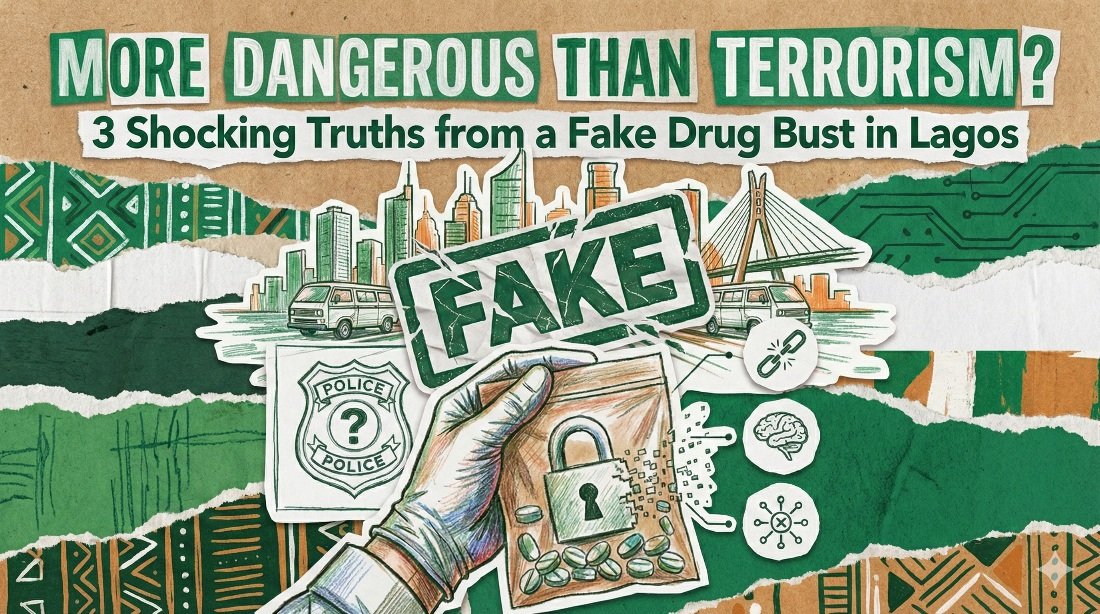
Every time we take a pill, we place our trust in a vast system of manufacturing, regulation, and distribution. We trust that the medicine will help, not harm. But a recent raid on Christmas Eve in Lagos has shattered that sense of security, revealing a threat that is not just criminal, but one that top officials consider a grave crime against humanity. The seizure of expired and repackaged malaria drugs by Nigeria’s National Agency for Food, Drug Administration and Control (NAFDAC) uncovers several shocking truths about the hidden dangers in our public health landscape. Here are the three most critical takeaways from this deeply disturbing event. Read Understanding the Seizure of Dangerous Malaria Drugs in Lagos.
The Proposed Punishment Isn’t a Fine—It’s the Death Penalty.
In a stunning departure from typical regulatory penalties, NAFDAC officials are now advocating for capital punishment for individuals who produce, repackage, or circulate fake or expired drugs. This is not just a passing sentiment; a formal proposal to implement this stricter punishment is already under consideration by the National Assembly.
Dr. Martins Iluyomade, NAFDAC’s Director of Investigation and Enforcement who led the raid, described the act as a “grave crime against humanity.” This position was forcefully echoed by the agency’s Director-General, Prof Mojisola Adeyeye, who argues that the punishment must fit the crime:
“Fake drugs or the repackaging of expired drugs, as seen in this case, should attract the death penalty. Someone relabelling drugs that expired in 2022 and 2024 is deliberately harming innocent Nigerians… Since these criminals are killing innocent people silently, they should also face the ultimate punishment to serve as a strong deterrent.”
This extreme stance re-frames the crime entirely. It moves beyond a simple counterfeit operation and defines it as an act of mass, deliberate harm, equivalent to premeditated murder on a societal scale.
This ‘Silent Killer’ is Being Called More Dangerous Than Terrorism.
According to Dr. Iluyomade, the activities of these perpetrators have a more devastating long-term impact on public health and human lives than terrorism. While the comparison may seem jarring, the logic is rooted in the insidious nature of the threat.
The danger, as NAFDAC’s Director-General Prof Mojisola Adeyeye explains, is the development of drug resistance. When people consume these drugs, their “immune systems become hardened against treatment,” rendering future life-saving medications ineffective. While terrorism is a visible, explosive threat that creates immediate destruction, the circulation of fake medicine is a silent, systemic threat that erodes public health from within, making entire populations more vulnerable to disease over time.
The Bust Was Triggered by Alert Neighbors, Not Just Officials.
This major public health threat wasn’t uncovered by a high-level government investigation alone. The warehouse was discovered because residents of the area were paying attention. Community members noticed “suspicious movements” around the four-storey building and took action, reporting the matter to the Ojo Police Station. The tip-off was taken so seriously that it prompted a site visit from both the local Divisional Police Officer and the Lagos State Commissioner of Police, Olohundare Moshood Jimoh, underscoring the perceived gravity of the threat.
The chairman of Ojo local government, Hon Muhibat Rufai, publicly praised this community action. She urged Community Development Associations (CDAs) to continue complementing government efforts by acting as “watchdogs in their neighbourhoods.” In a fight against a threat as insidious as fake medicine, this raid proves that the first line of defense isn’t a government agency, but an engaged neighborhood refusing to look the other way.
The Christmas Eve raid in Lagos was more than just another seizure of illegal goods. It exposed a frightening reality and a radical new response from regulators. The call for capital punishment, the comparison of this crime to terrorism, and the critical role of community watchfulness are three powerful takeaways that demand our attention. They force us to confront a difficult question.
When the biggest threats to public health might be hiding in plain sight, who is ultimately responsible for keeping us safe?






Leave a comment