

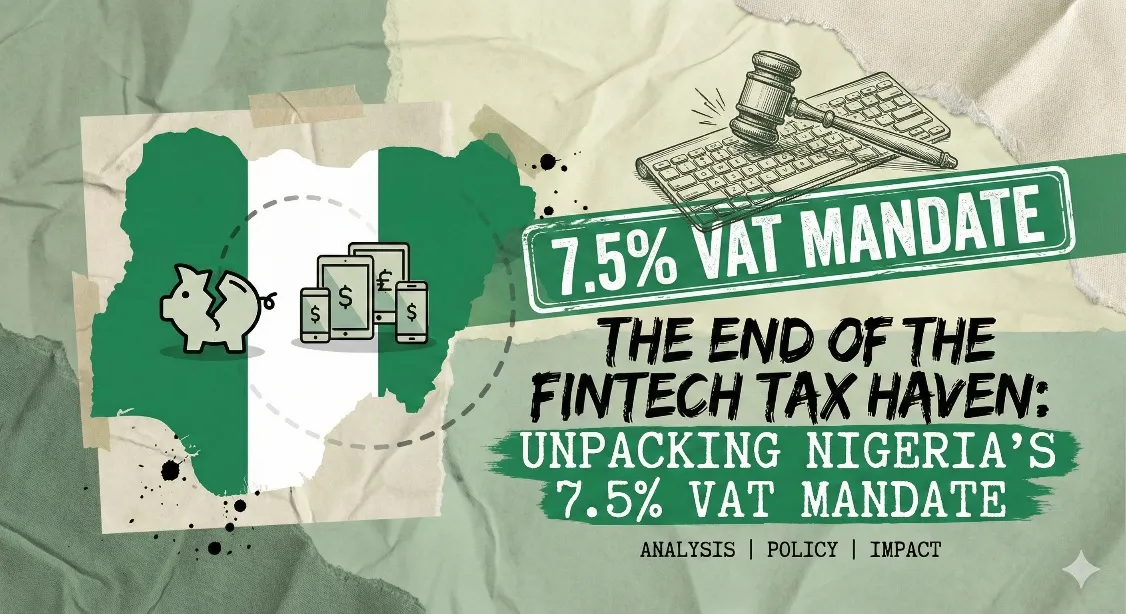
Digital banking has long been the heartbeat of the Nigerian economy, offering a frictionless escape from the long queues of traditional brick-and-mortar institutions. However, the era of the “frictionless” tax-free digital transaction is drawing to a close. On January 15, 2026, the Federal Government issued a definitive directive requiring all banks and fintech platforms to collect and remit a 7.5% Value-Added Tax (VAT) on service fees. With the implementation date set for Monday, January 19, 2026, the four-day window signals a new era of fiscal urgency and digital financial oversight. Read on Business Expense Deductions in Nigeria: A Simple Guide for New Entrepreneurs (Based on the Tax Act of 2025).
Takeaway 1: Taxing the Fee, Not the Funds
For the average consumer, the most critical distinction to grasp is that this tax is levied on the service charge, not your principal capital. The 7.5% VAT applies specifically to electronic banking charges, including mobile money transfers, USSD transaction fees, and one-time costs like card issuance fees.
To see how this affects your “bottom line,” consider a standard mobile transfer. If your bank or fintech charges a N100 service fee for a transaction, the 7.5% VAT adds N7.50 to that fee. In this scenario, while you may be transferring N5,000, your total cost out of pocket will be N107.50 (Principal + Fee + VAT). By taxing the service rather than the wealth, the government aims to generate revenue without directly eroding the capital Nigerians use for daily trade.
Takeaway 2: Uniformity Across the Sector
The directive effectively closes what many perceived as a “fintech tax haven.” While VAT on banking services is not an entirely new concept, the Nigerian Revenue Service (NRS) is now enforcing uniform collection rules across the board. This mandate explicitly includes traditional commercial banks, fintech giants like Moniepoint, and microfinance banks—the latter being a crucial pillar for financial inclusion among lower-income earners.
This move levels the playing field, ensuring that “neobanks” and electronic money operators no longer hold a tax-avoidance advantage over traditional institutions. As Moniepoint noted in a recent communication to its users:
“Moniepoint is required to collect and remit VAT to the Nigerian Revenue Service… this is not a price increase but a statutory obligation.”
Takeaway 3: The Safe Havens—What Remains Tax-Free
Despite the broader revenue drive, the government has carved out specific exemptions to protect savers. According to the directive, interest earned on deposits and savings remains exempt from VAT. This is a vital silver lining; it ensures that the returns on your hard-earned savings are not diminished by this particular tax reform. By keeping interest tax-free, the policy attempts to balance the need for revenue with the necessity of encouraging Nigerians to keep their funds within the formal financial system.
Takeaway 4: The NRS Rebranding and Enforcement Surge
The timing of this enforcement coincides with a major institutional pivot: the transition of the Federal Inland Revenue Service (FIRS) to the Nigerian Revenue Service (NRS). This is not merely a cosmetic name change; it represents a more aggressive “Tax Reform” posture.
The brief window between the announcement on January 15 and the January 19 deadline underscores a government in a hurry to formalize digital financial oversight. The NRS is clearly signaling that the digital economy is no longer a peripheral frontier, but a primary engine for national resource mobilization.
Takeaway 5: Transparency and the “Tax Act” Reality
Account holders must also navigate the coexistence of VAT with the N50 stamp duty. Following the provisions of the new Tax Act, the charge previously known as the Electronic Money Transfer Levy (EMTL) has been formally reclassified as stamp duty. This N50 fee applies to all electronic transfers of N10,000 and above.
In a significant win for consumer protection, the government has ordered banks to itemize these charges separately. The era of the “blind” transaction—where fees were often lumped together—is ending. Your transaction statements must now clearly distinguish between the service fee, the 7.5% VAT on that fee, and the N50 stamp duty where applicable. This transparency allows for greater oversight, ensuring that institutions do not use the new mandate to mask unauthorized price hikes.
Conclusion
Nigeria is at a fiscal crossroads. The shift toward a more regulated, revenue-focused digital landscape is an inevitable byproduct of a maturing economy. While the added costs may feel like a burden to the individual, they represent a systemic effort to integrate the massive volume of digital transactions into the national budget. As we move past the January 19 deadline, the nation must grapple with a difficult question: Can Nigeria continue to drive digital financial inclusion while simultaneously tightening the tax net on the very services that made that inclusion possible?







Leave a comment