

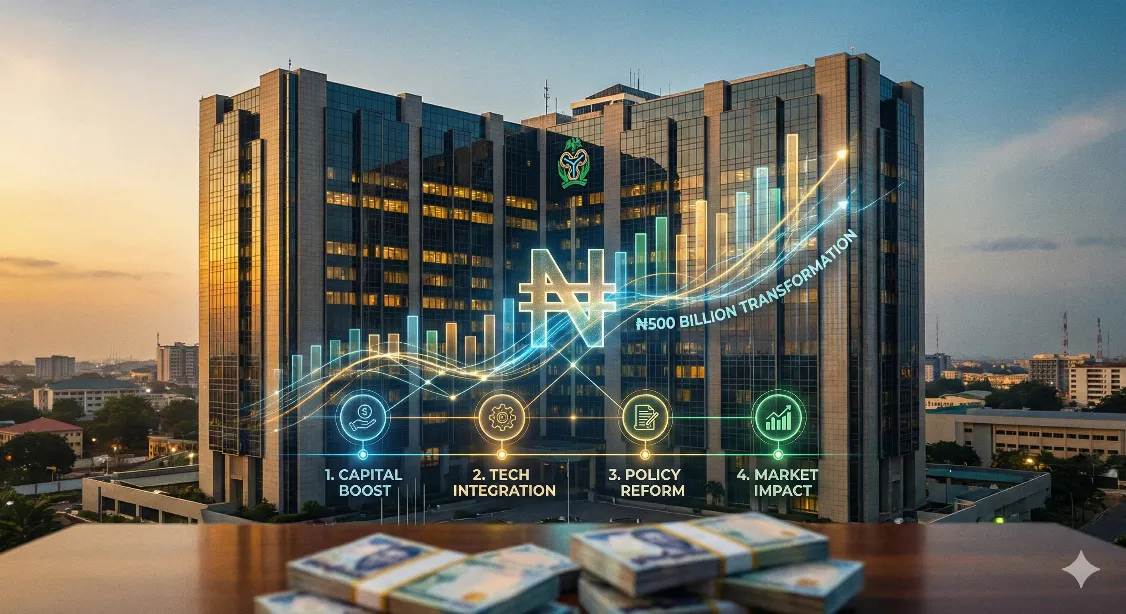
The countdown to March 31, 2026, is no longer a distant regulatory deadline; it is the zero hour for a fundamental restructuring of Nigeria’s financial DNA. This is not a mere box-ticking exercise in capital adequacy, but a high-stakes pivot intended to fortify the nation’s economic engine against global volatility. Speaking at the 2026 Macroeconomic Outlook organized by the Nigerian Economic Summit Group (NESG) in Lagos, Dr. Muhammad Abdullahi, the Central Bank of Nigeria’s (CBN) Deputy Governor for Economic Policy, provided a sobering yet optimistic progress report. His update reveals a sector in the midst of a massive “thinning of the herd,” where only the most resilient will survive to carry the Nigerian flag into the global financial arena. Read on CBN’s N192M Payday: 4 Key Realities of Nigeria’s New BDC Rules.
The Leaders and the Laggards: Momentum in the Final Stretch
As of January 15, 2026, the industry is split between those who have secured their future and those still gasping for air. Dr. Abdullahi confirmed that 20 commercial banks have now successfully crossed the new capital threshold. This is a notable increase from the 19 banks cleared just nine days earlier on January 6, signaling a late-cycle surge in compliance velocity. Read on 5 Surprising Ways Nigeria’s 2025 Tax Act Rewrites the Rules of Business.
However, the “momentum” of the exercise also highlights a stark reality: 13 banks are still racing against the clock. This 20-out-of-33 ratio is the definitive mid-cycle health indicator for the industry. For these remaining 13 laggards, the strategic options are narrowing by the day. We are likely to see a flurry of forced consolidations or mergers as the March deadline approaches, as the CBN appears uninterested in granting extensions for those who cannot meet the bar. The industry is effectively being bifurcated into a dominant “cleared” class and a struggling “at-risk” tier.
Beyond the Balance Sheet: A Strategic Pivot to Productive Lending
Perhaps the most critical takeaway from the NESG briefing was the CBN’s evolving mandate. For the apex bank, hitting a specific capital number is the beginning, not the end, of the journey. Dr. Abdullahi was clear: the priority has shifted from simple financial system stability to ensuring that this newly “fortified” capital actually works for the Nigerian economy. The conversation is moving from “bank safety” to “macroeconomic growth.”
“The focus that we really are turning our attention to, especially from the financial system stability side, is that we ensure that a strengthened capital base translates into credit that is productive, that is well-targeted, and that is sustainable.”
For the Nigerian business owner, this is the most vital piece of the puzzle. The CBN is signaling that it will no longer tolerate banks that sit on idle capital or focus solely on low-risk government securities. The “new” Nigerian bank is expected to be a conduit for sustainable credit, targeting productive sectors that drive GDP rather than just padding institutional reserves.
Defining the New Financial Hierarchy: Strategic Bifurcation
The recapitalization framework has created a clear and aggressive pecking order. By setting vastly different entry prices for different licenses, the CBN is intentionally creating a tiered landscape that separates niche players from global giants. The requirements are as follows:
- International Banks: ₦500 billion
- National Banks: ₦200 billion
- Merchant Banks: ₦50 billion
- Non-interest Banks: ₦10 billion to ₦20 billion
The strategy here is a deliberate “thinning of the herd.” The ₦500 billion requirement for international banks is ten times that of a Merchant Bank, a massive capital chasm that forces institutions to choose between being a global powerhouse or a specialized niche player. This tiered approach effectively eliminates the “middle-class” bank that is too large to be a specialist but too small to compete globally, forcing a more efficient allocation of capital across the banking system.
Inside the CBN “War Room”: Managing the Velocity of Reform
Behind the public updates lies an administrative marathon. The internal environment at the CBN has been transformed into a “war room,” with officials working around the clock to vet applications, verify capital sources, and process complex filings. The “huge” workload described by Dr. Abdullahi suggests that the CBN is not merely receiving reports but is actively interrogating the quality of the capital being injected.
“They’re huge. It’s very busy within CBN today, tomorrow, and through to March, as you can imagine.”
This administrative intensity underscores the urgency of the final window. As banks meet the requirement “every day,” the CBN faces a potential bottleneck of applications. This “War Room” reality suggests that the final three months will be the most volatile period of the entire two-year window, as the remaining 13 banks attempt to squeeze through an increasingly narrow regulatory door.
The Road to April 2026
When the dust settles on April 1, 2026, the Nigerian banking sector will be unrecognizable compared to its 2024 state. The success of the 20 banks that have already complied proves that there is sufficient liquidity and appetite for the CBN’s vision. However, the ultimate success of this ₦500 billion transformation will not be measured by the size of the balance sheets, but by the movement of the credit needle. Will these super-sized banks finally unlock the “well-targeted” lending required to catalyze a new era of Nigerian prosperity, or will we simply have larger institutions with the same old risk aversions? The answers will begin to emerge the moment the “War Room” doors finally close this March.






Leave a comment