

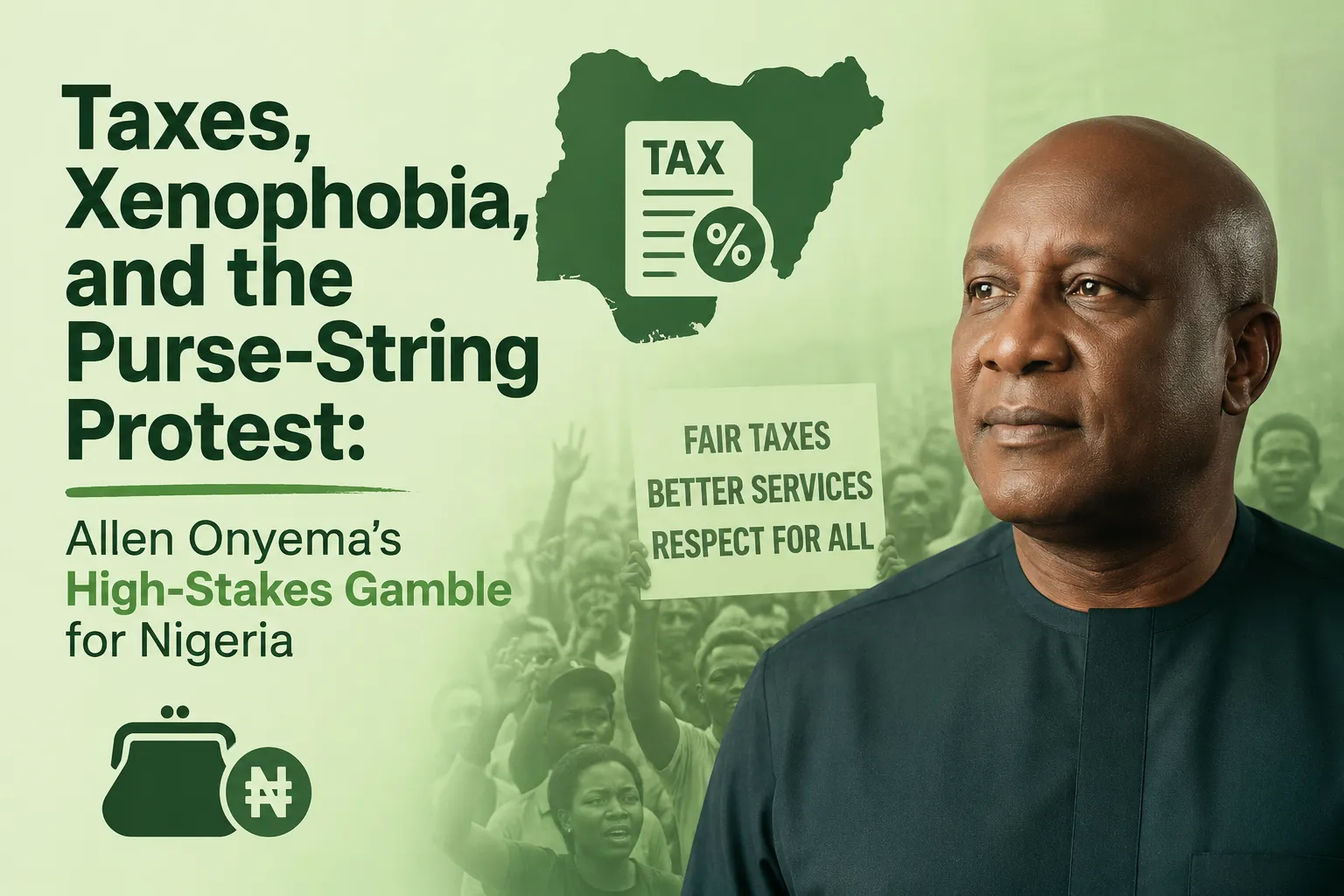
Nigeria currently finds itself at a precarious intersection where the fragility of domestic industry meets a growing crisis of international diplomacy. For years, the narrative of Nigerian aviation has been one of high-altitude ambition grounded by low-level administrative friction. Simultaneously, the recurring trauma of xenophobic violence in South Africa has tested the limits of Abuja’s diplomatic patience. Read Nigerian Banks Are Passing Tax Compliance Costs to You — Here Is What Changes in Your Wallet.
At the center of these converging storms is Allen Onyema, the Vice President of the Airline Operators of Nigeria (AON) and CEO of Air Peace. Onyema is no longer merely requesting policy tweaks; he is demanding a fundamental recalibration of how Nigeria protects its own—both the capital at home and the citizens abroad. His dual-front challenge to the status quo suggests that the survival of the Nigerian spirit depends on a new kind of sovereign self-assertion: one driven by economic leverage rather than bureaucratic inertia.
The “Invisible” Tax Burden: Why Airlines are Collapsing
Onyema’s critique of the aviation sector exposes a structural flaw that he deems “burdensome and unsustainable.” Specifically, he points to the 5% passenger service charge collected by the Nigerian Civil Aviation Authority (NCAA) as a form of fiscal parasitism. While regulators often deflect criticism by claiming that “passengers pay the fee,” Onyema’s economic logic is sharp and dismissive of such administrative opacity.
The lethality of this levy lies in the “gross vs. net” reality of the business. In a low-margin, high-overhead industry, taking 5% off the top of a N100,000 ticket—regardless of whether the airline makes a profit—is a recipe for bankruptcy. For Onyema, this is not a partnership; it is a penalty on entrepreneurial risk.
“When we speak, they will say passengers are the ones paying, but we refuse to accept that. If I charge N100,000, NCAA takes five per cent of that money. We did not set up the business with them.”
The Call for Technocratic Oversight
To rectify this, Onyema has bypassed standard lobbying to appeal directly to President Bola Tinubu for a radical shift toward technocratic transparency. He is calling for the immediate formation of an independent aviation taxes and charges review committee. This is not a request for another government panel of career bureaucrats, but a demand for a high-level body of “independent professionals” capable of clinical analysis.
Onyema proposes the committee include:
- Technocrats and independent professionals
- Aviation experts
- Industry operators with direct business skin-in-the-game
The rationale is clear: to ensure the Presidency is no longer being “fooled” by misleading data or self-serving regulatory narratives. By placing the industry’s health in the hands of those with “great aviation knowledge,” Onyema argues the government can finally distinguish between legitimate revenue collection and the levies responsible for the “demise of many airlines.”
Strategic Retaliation: The Power of the Economic Boycott
Onyema’s philosophy of leverage extends beyond the runway into the volatile realm of South African xenophobia. He pulls no punches in his critique of the South African security apparatus, questioning how a modern state “lacks a police force” or “military” exactly when foreign nationals are being profiled and harassed.
However, his call for retaliation is a sophisticated departure from the “foolishness” of street violence or property destruction. Onyema advocates for a disciplined, non-violent economic boycott. He frames the presence of Nigerians in South Africa not as a burden to be managed, but as a “Capital Export” that South Africa has failed to respect.
“I totally agree that there should be a stop to foolishness.”
A Nuanced Approach to Foreign Business in Nigeria
Despite his firebrand rhetoric, Onyema offers a surprisingly nuanced defense of South African-owned giants like MTN operating within Nigeria. This is the hallmark of a business-first strategist: he recognizes that attacking these entities would be “friendly fire.” Because Nigerians hold significant shares in these companies, their destruction would effectively be an act of economic self-harm.
Instead, he highlights a missed opportunity for the South African populace. He argues that Nigerians in South Africa have acted as a masterclass in entrepreneurship, bringing their own capital to open shops and create local jobs. The “retaliation” he seeks is not the closing of businesses in Lagos, but a realization in Pretoria that Nigeria’s entrepreneurial class is a partner to be learned from, not a target to be bullied.
The “Financial Withdrawal” Philosophy
At its core, Onyema’s strategy is built on the concept of financial withdrawal—the ultimate tool of the modern sovereign state. He posits that the power of the purse is far more potent than the power of the protest. By withholding patronage and investment from South Africa, Nigerians can exert a pressure that diplomatic cables cannot achieve.
This vision allows for engagement but dictates the terms: if South Africans wish to invest in Nigeria, they are welcome to bring their money, but Nigeria must determine how that capital is extracted. It is a philosophy of “non-violent action” that uses the withdrawal of support as a primary weapon of statecraft.
Conclusion: A New Era of Economic Sovereignty?
Allen Onyema’s two-pronged message represents a significant pivot for Nigerian industry. By demanding a technocratic purge of internal “fiscal parasitism” and advocating for a disciplined external boycott, he is sketching a blueprint for a more assertive Nigeria. It is a strategy that moves the nation away from being a passive recipient of policy and toward becoming an active architect of its economic destiny.
As the Tinubu administration weighs these proposals, the broader question remains: In an era where traditional diplomacy often fails to protect citizens abroad, will the strategic withdrawal of economic support become the new standard for asserting national dignity? For Onyema, the answer is clear: it is time to stop the foolishness and start using the power of the purse.





Leave a comment