

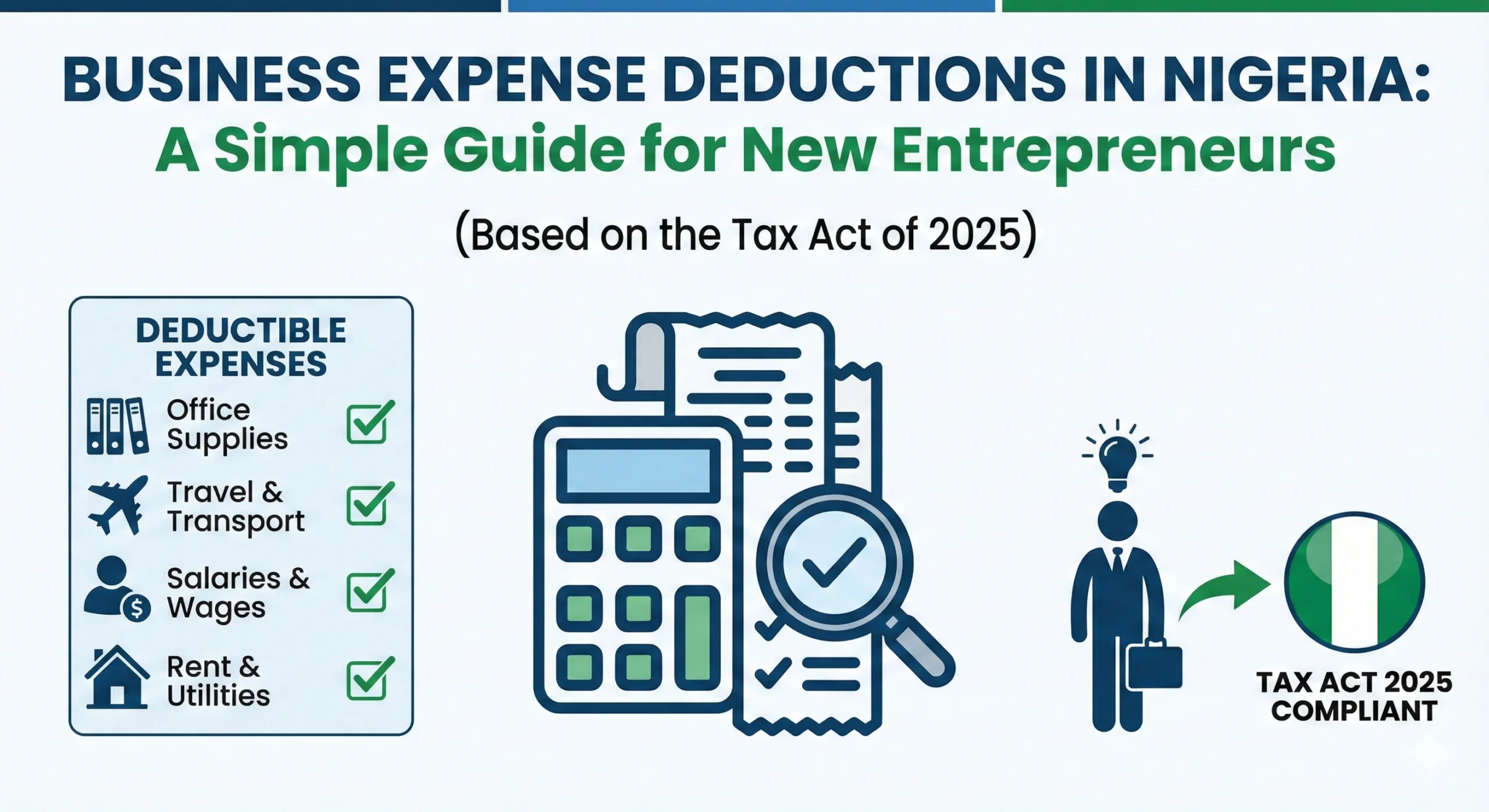
Welcome to the world of entrepreneurship! As you build your business, one of the most crucial financial skills you’ll develop is understanding your tax obligations. A key part of this is knowing which business expenses you can legally deduct from your income before calculating the tax you owe. Mastering this helps you determine your true taxable profit, manage your cash flow effectively, and build a financially sound company from day one. This guide simplifies the fundamental rules on deductible and non-deductible expenses as laid out in the Nigeria Tax Act of 2025.
Read: Strategic Memorandum: Tax Implications of Business Restructuring under the Nigeria Tax Act, 2025
This understanding begins with one central principle that governs all business deductions.
2.0 The Golden Rule of Business Deductions
For any business expense to be considered for a tax deduction in Nigeria, it must pass a fundamental test. This core principle, found in Section 20(1) of the Tax Act, is the foundation for all allowable claims.
The expense must be “wholly and exclusively incurred in the production of the income.”
For a new business owner, this means you must be able to demonstrate a clear and direct link between the money you spent and your efforts to generate revenue. If an expense was for a dual private and business purpose, or if it wasn’t directly necessary for your business operations, it fails this test and cannot be deducted.
For example, the laptop you buy for your graphic design business is wholly and exclusively for producing income and is deductible. However, if you use that same laptop 50% of the time for personal movie streaming, only 50% of its cost would be deductible. The portion for personal use fails the ‘exclusively’ test.
With this Golden Rule in mind, let’s look at the specific types of expenses the Tax Act allows.
3.0 Allowable Deductions: What You CAN Claim
The Tax Act of 2025 provides a list of common business expenses that are deductible, as long as they meet the “Golden Rule.” Understanding these categories will help you structure your bookkeeping and ensure you claim everything you’re entitled to.
- Employee Costs: Salaries, wages, and other benefits you pay to your employees are a primary operating cost and are deductible, directly reducing your taxable profit.
- Advisor’s Note: This includes the employer’s portion of pension contributions and any other staff welfare costs. Ensure you are fully compliant with Pay-As-You-Earn (PAYE) tax regulations for all employees, as non-compliance can create other tax problems.
- Office and Workspace Rent: The rent you pay for the land or buildings used for your business operations can be claimed, reducing the taxable burden of your physical location costs.
- Advisor’s Note: If you run your business from home, you can deduct the portion of your rent and utilities that corresponds to the space used exclusively for your business. Calculate the square footage of your home office as a percentage of your total home size and apply that percentage to your bills. Meticulous records are key here.
- Repairs and Maintenance: Costs for repairing your business premises, machinery, or essential equipment are deductible, allowing you to maintain your business assets without being taxed on the upkeep.
- Advisor’s Note: Be careful to distinguish between a ‘repair’ (which is deductible) and an ‘improvement’ (which is a capital expense). Fixing a broken window is a repair. Replacing all windows with energy-efficient models is an improvement and would be capitalized, not expensed at once.
- Interest on Business Loans: If you borrow money specifically to fund your business activities, the interest you pay on that loan is a deductible expense, making it more tax-efficient to finance your growth.
- Advisor’s Note: You must be able to prove the loan was used for the business. Keep loan agreements and bank statements that clearly show the funds entering the business account and being used for business purposes, not personal expenses.
- Pension Contributions: Your contributions as an employer to an approved staff pension or retirement fund are deductible. This allows you to reduce your taxable profit while also offering a competitive benefit to attract and retain talented employees.
- Advisor’s Note: The key word here is “approved.” Contributions are only deductible if they are made to a scheme that is officially approved under the Pension Reform Act. Ensure your chosen pension administrator is fully licensed and compliant.
- Bad Debts: If a specific debt owed to your business (e.g., from a customer who hasn’t paid an invoice) becomes unrecoverable, you can deduct this amount. This acknowledges that not all invoiced sales result in actual cash received.
- Advisor’s Note: You must be able to prove you have taken reasonable steps to recover the debt and that it has genuinely become ‘bad’. A general provision for doubtful debts in your accounts is not deductible; you must identify specific, unrecoverable debts.
- Research and Development (R&D): Expenses you incur on research and development activities for your business are allowable deductions, providing a tax-efficient way to innovate and improve your products or services.
- Advisor’s Note: Keep detailed records of your R&D projects, including objectives, processes, and a breakdown of associated costs like materials and staff time. This will be crucial for substantiating your claim if the tax authorities ask for proof.
- Pre-Commencement Expenses: You can deduct certain business expenses that were incurred up to six years before your business officially started operating. This allows you to claim legitimate setup costs that were paid for before you made your first sale.
- Pro-Tip: This is a crucial benefit for startups. Keep every receipt from day one—for company registration, initial software subscriptions, legal consultations, etc. These costs, incurred even before you made your first sale, can be claimed to reduce your first-year taxable profit.
Just as the law specifies what is allowed, it also clearly outlines what is not.
4.0 Non-Deductible Expenses: What You CANNOT Claim
The Tax Act also specifies certain types of expenses that cannot be deducted from your business income to calculate your taxable profit. It’s crucial to know these to avoid making incorrect claims.
| Type of Expense | Simple Explanation of Why It’s Not Deductible |
| Capital Expenditure | The cost of buying major, long-term assets (like vehicles, buildings, or heavy machinery) cannot be deducted all at once. Instead, the cost is recognized over several years through a system of ‘capital allowances.’ (Think of capital allowances as the tax-approved version of depreciation, allowing you to deduct a portion of the asset’s cost each year of its useful life, as specified by tax law.) Advisor’s Note: While you can’t expense a new delivery truck immediately, you will get tax relief for it over time. This distinction is fundamental: operating costs are deducted now, while capital costs are deducted gradually via capital allowances. |
| Private or Domestic Expenses | Any expense that is for personal or home use, rather than for the business, is not deductible. This reinforces the “wholly and exclusively” rule. Advisor’s Note: This is the most common area for mistakes. A business trip lunch with a client is deductible; your daily personal lunch is not. The line can be blurry, so always ask yourself: “Would I have spent this money if it weren’t for my business?” If the answer is no, it’s likely deductible. |
| Taxes on Profit | You cannot deduct the income tax itself as an expense. The tax is calculated on your profit, so it can’t be used to reduce that same profit. Advisor’s Note: Think of it this way: income tax is the result of your profit calculation, not an input into it. Allowing it as a deduction would create a never-ending circular calculation. |
| Penalties and Fines | You cannot claim a tax deduction for any penalties or fines you have to pay for breaking the law (e.g., a traffic fine or a regulatory penalty). Advisor’s Note: The government’s policy is clear: it will not provide tax relief for illegal activities. Deducting a fine would be equivalent to the government subsidizing your penalty. |
| Depreciation of Assets | While your internal accounting records will show depreciation, the tax law does not allow it as a direct deduction. Tax relief for asset costs is given through the specific rules of capital allowances instead. Advisor’s Note: This is a technical but important point. Depreciation is an accounting concept for spreading an asset’s cost. Capital Allowance is the tax-law equivalent. They are calculated differently, so always use the official capital allowance rates for your tax returns, not your internal depreciation figures. |
| Sums Recoverable by Insurance | If you incur a loss or an expense that is later paid back to you by an insurance company, you cannot also claim that amount as a tax-deductible expense. Advisor’s Note: This prevents “double-dipping.” If your business laptop is stolen and your insurance reimburses you for the full cost, you haven’t truly incurred a loss, so there is nothing to deduct. If the insurance only pays out 80% of the cost, you may be able to claim the remaining 20% loss. |
Ultimately, navigating business deductions comes down to one core practice: diligent and organized record-keeping. Every allowable expense discussed in this guide is only claimable if you have the proof to back it up. By understanding these fundamental rules from the Tax Act of 2025 and maintaining meticulous records of your income and expenses, you build a strong foundation for financial compliance, effective cash management, and long-term business success.








Leave a comment