
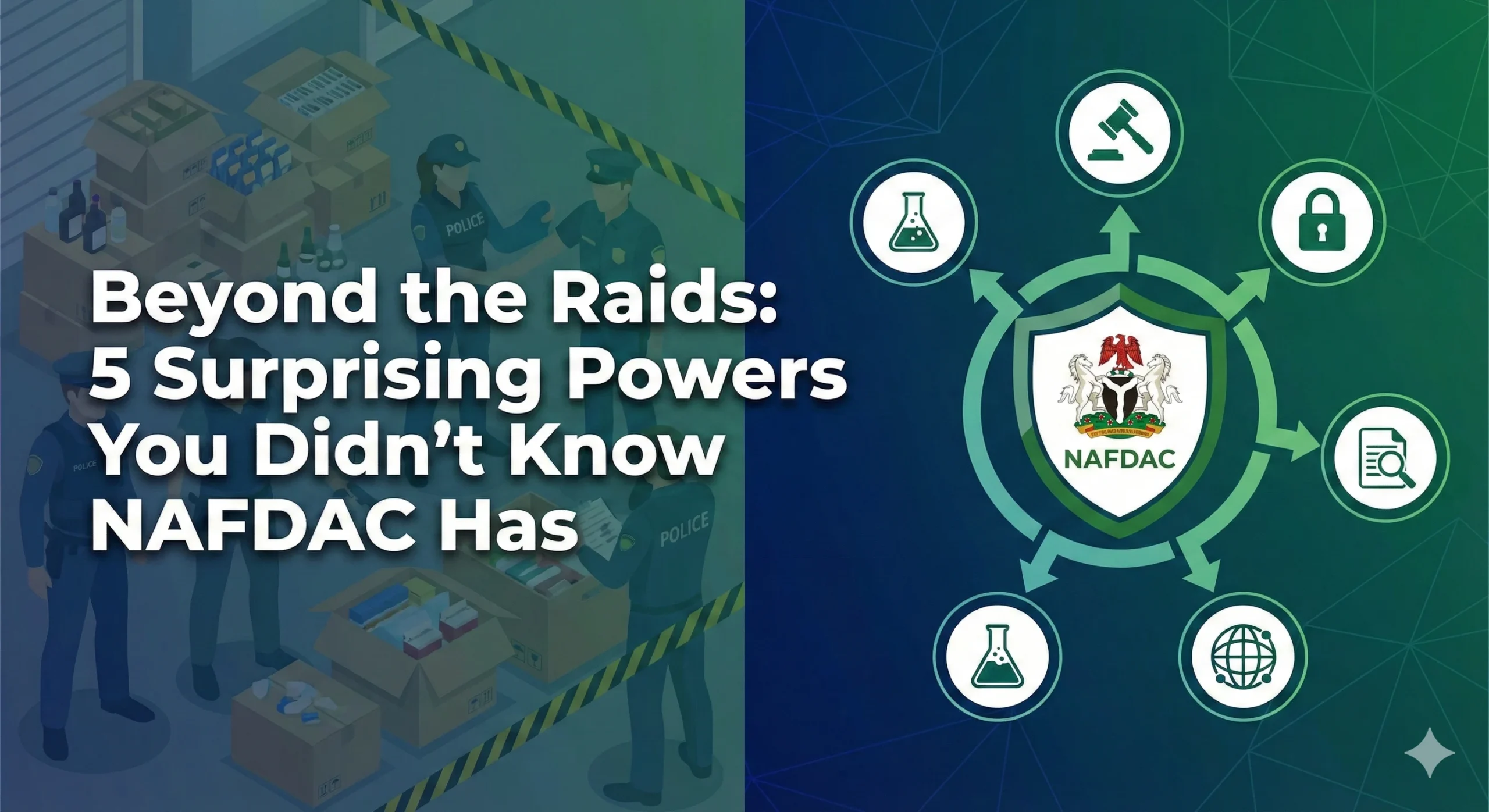
When most people think of the National Agency for Food and Drug Administration and Control (NAFDAC), the image that often comes to mind is of officers raiding markets to seize counterfeit drugs. While that is a critical function, the agency’s true power, as defined by its founding legal document, the NAFDAC Act, is far broader and more surprising than commonly understood. This article uncovers five of the most impactful powers drawn directly from the Act, revealing an agency with a vast mandate and unique authority. Read on Understanding NAFDAC: Nigeria’s Guardian of Public Health
1. Their Watch List is Wider Than You Think
It’s Not Just Food and Drugs.
While the name highlights food and drugs, NAFDAC’s regulatory scope is significantly wider. Section 5(a) of the Act explicitly grants the agency the function to “regulate and control the importation, exportation, manufacture, advertisement, distribution, sale and use of food, drugs, cosmetics, medical devices, bottled water and chemicals.” This broad mandate is significant, positioning NAFDAC to oversee the entire lifecycle of products that touch every Nigerian’s life daily—from the bottled water you drink and the cream on a store shelf to industrial chemicals and hospital instruments. This expansive reach makes it one of the most powerful consumer protection agencies in the country.
2. A Regulator That Can Turn a Profit
NAFDAC Can Act Like a Business.
Unlike many government agencies, the NAFDAC Act grants the agency a surprising degree of financial autonomy. The Act includes several unique provisions:
- It is exempt from income tax on all its derived income (Section 15).
- It has the authority to accept gifts of land, money, or other property (Section 23).
- Most notably, it can “invest in the profitable production of capital goods” (Section 16) and “invest any surplus funds in profit yielding ventures” (Section 17).
These powers are designed to reduce the agency’s dependence on potentially unreliable government subventions. This financial autonomy allows NAFDAC to fund its own enforcement actions, laboratory upgrades, and research initiatives, ensuring it has the resources to execute its mandate effectively.
3. Unprecedented Access: The Power to Enter and Seize
They Don’t Always Need to Knock.
The NAFDAC Act provides its officers with formidable enforcement powers to ensure compliance. Under Section 24, an officer can, in the course of their duty, enter any premises in which he reasonably believes that regulated products are being handled. The most striking part of this authority is the level of access it permits. As stated in Section 24(1)(a), an officer may:
…enter (if need be by force) any premises…
This authority to use force to gain entry underscores the seriousness of the agency’s mandate. It is a necessary tool for effective enforcement, especially when dealing with clandestine counterfeiters operating secretively to evade regulation.
4. Industry Insiders Have a Seat at the Table
The Watchdog and the Watched, Working Together.
One of the most counter-intuitive aspects of NAFDAC’s structure is the composition of its Governing Council, which includes representatives from the very industries it regulates. According to Section 2 of the Act, the Council includes “One person to represent the Pharmaceutical Group of the Manufacturers Association of Nigeria” and “One person to represent the Food Beverages Group of the Manufacturers Association of Nigeria.”
However, this is not a case of industry capture. The Act balances these voices by creating a multi-stakeholder governance structure. The council also includes representatives from the Federal Ministry of Health, the Standards Organisation of Nigeria, the National Drug Law Enforcement Agency (NDLEA), and the Pharmacists Board of Nigeria, alongside public interest appointees. This design ensures that industry perspectives are considered alongside scientific, enforcement, and public safety concerns, fostering collaboration in crafting practical and effective regulations.
5. Corporate Shield? Not for Company Directors.
The Buck Stops at the Director’s Desk.
The NAFDAC Act contains a powerful provision that pierces the corporate veil to hold leaders personally accountable. Section 25(4) states that if a company commits an offense, any director, manager, or similar officer who consented to it, connived in it, or contributed to it through neglect “shall be deemed to be guilty of the offence” along with the company. A convicted individual is liable to a fine of N100,000.
While the principle of personal liability remains a powerful legal tool, the monetary penalty of N100,000, set in 1993, is arguably outdated as a financial deterrent. The true power of this clause today lies in the risk of a personal criminal conviction and the immense reputational damage for directors, ensuring that senior leadership cannot hide behind a corporate name when public safety is at stake.
Conclusion: A Framework for Safety
Ultimately, the NAFDAC Act crafts an agency that is not merely a reactive police force for counterfeit goods, but a proactive, quasi-entrepreneurial regulator with deep structural power over Nigeria’s entire consumer landscape. Knowing the depth and breadth of these powers, how does it change your perception of the labels and products you trust every day?






Leave a comment