
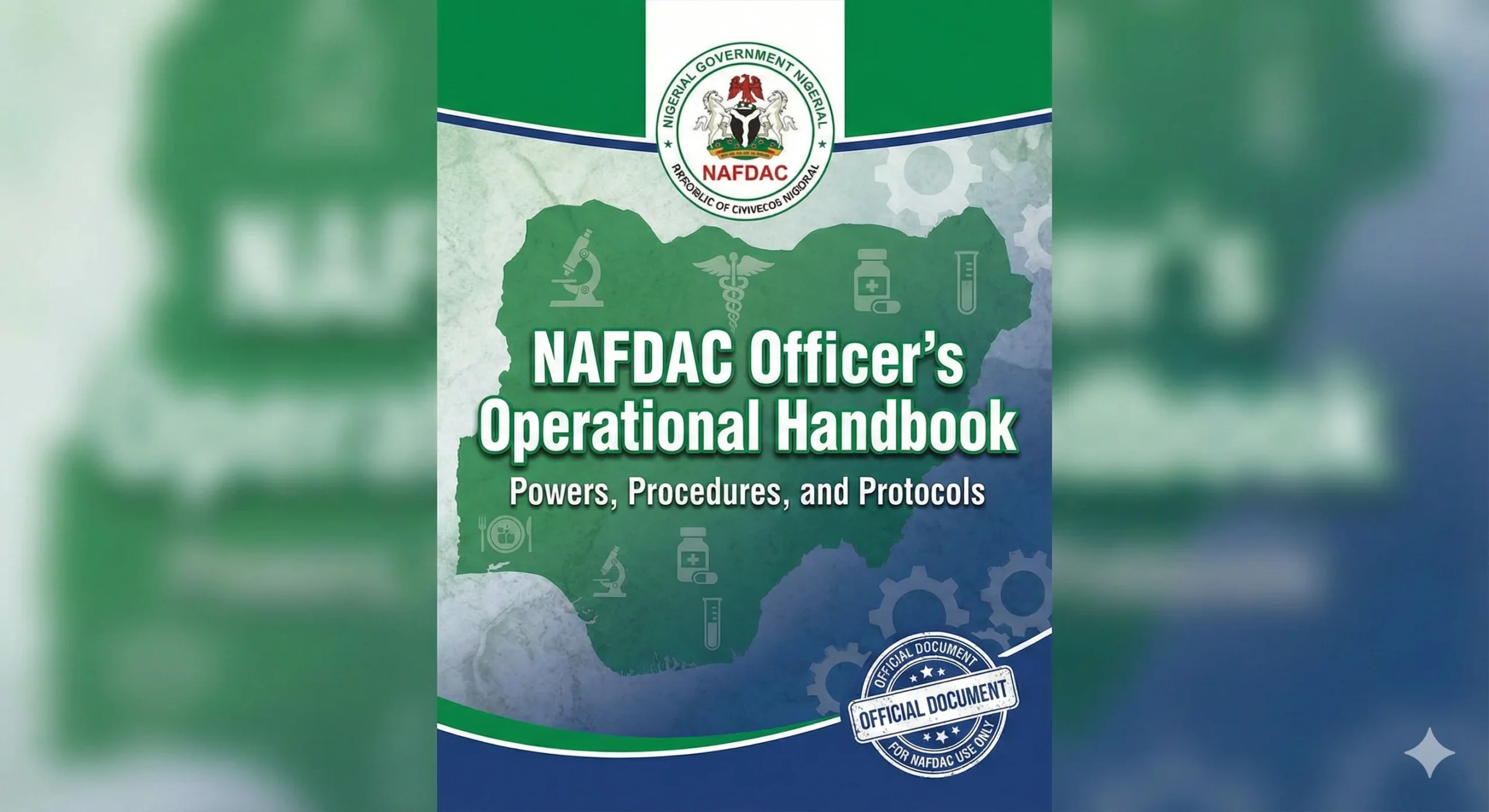
This handbook serves as the primary operational guide for all officers of the National Agency for Food and Drug Administration and Control (NAFDAC). It is grounded in the legal authority of the NAFDAC Act and is designed to ensure the consistent, lawful, and effective execution of your duties. Adherence to these protocols is essential for upholding the Agency’s mandate to protect public health, ensuring the integrity of our enforcement actions, and maintaining the trust of the Nigerian public. This document outlines your powers, the procedures for field operations, standards of professional conduct, and the legal framework that governs our work. Read on Beyond the Raids: 5 Surprising Powers You Didn’t Know NAFDAC Has.
Core Agency Functions
As an officer of the Agency, your actions directly contribute to fulfilling our statutory responsibilities. The core functions of NAFDAC, as detailed in Section 5 of the Act, are:
- Regulating and controlling the importation, exportation, manufacture, advertisement, distribution, sale, and use of food, drugs, cosmetics, medical devices, bottled water, and chemicals.
- Conducting appropriate tests and ensuring compliance with standard specifications to control the quality of regulated products, their raw materials, and production processes.
- Undertaking investigations into production premises and raw materials to establish relevant quality assurance systems, including the certification of production sites and products.
- Inspecting imported regulated products and establishing quality assurance systems for them.
- Compiling standard specifications and guidelines for the production, importation, exportation, sale, and distribution of all regulated products.
- Undertaking the registration of food, drugs, cosmetics, medical devices, bottled water, and chemicals.
- Controlling the exportation and issuing quality certification for regulated products intended for export.
- Establishing and maintaining relevant laboratories in strategic areas of Nigeria to support the performance of Agency functions.
- Pronouncing on the quality and safety of regulated products after appropriate analysis.
- Undertaking measures to ensure the use of narcotic drugs and psychotropic substances is limited to medical and scientific purposes.
- Granting authorization for the import and export of narcotic drugs and other controlled substances.
- Collaborating with the National Drug Law Enforcement Agency (NDLEA) to eradicate drug abuse.
- Advising Federal, State, and local governments, as well as the private sector, on quality, safety, and regulatory provisions.
- Undertaking and coordinating research programmes on the storage, adulteration, and rational use of regulated products.
- Issuing guidelines on, approving, and monitoring the advertisement of regulated products.
- Compiling and publishing relevant data resulting from the performance of Agency functions.
- Sponsoring relevant national and international conferences as it may consider appropriate.
- Liaising with relevant establishments within and outside Nigeria in pursuance of the functions of the Agency.
- Determining the suitability of medicines, drugs, food products, cosmetics, medical devices, or chemicals for human and animal use.
- Carrying out all other activities necessary or expedient for the performance of these functions.
To achieve these critical functions, the NAFDAC Act grants you specific powers and authority. The following sections provide a detailed guide to exercising these powers during field operations.
2.0 Officer Powers and Field Operations: A Procedural Guide
Field operations are the frontline of the Agency’s public health mandate. The powers vested in you under Section 24 of the Act are the primary tools for enforcing safety standards and removing harmful products from circulation. Meticulous adherence to correct procedure is paramount. It ensures that any evidence collected is admissible in legal proceedings and minimizes the risk of legal challenges against the Agency, thereby strengthening the impact of our regulatory actions.
2.1 Authority to Enter and Inspect Premises
Your authority to enter and inspect premises is legally defined and must be exercised with professionalism and diligence. Under Section 24(1) of the Act, an officer may enter any premises where they reasonably believe a regulated article is manufactured, prepared, stored, or sold. This authority is subject to three key preconditions:
- Acting in the Course of Duty: You must be performing your official functions as a NAFDAC officer.
- Operating at a Reasonable Time: Entry should be conducted during normal business hours or at other times that are reasonable under the circumstances.
- Producing a Certificate of Designation: If required by the person in charge of the premises, you must present your official NAFDAC identification.
The Act provides for entry “if need be by force.” This is a measure of last resort. It should only be considered when access is explicitly denied and when you have a reasonable belief that a significant violation of the Act is occurring, which requires immediate intervention to prevent harm or the destruction of evidence.
2.2 Standard Operating Procedures During Inspection
Once lawfully on the premises, an officer is empowered by Section 24(1)(b-e) to perform a range of investigative actions. These procedures are designed to allow for a thorough and lawful inspection.
- Examine Articles and Equipment: You have the authority to examine any article that appears to be a regulated product (food, drug, cosmetic, etc.). This includes the authority to examine any equipment or materials reasonably believed to be used in the manufacture, preparation, preservation, packaging, or storage of such an article.
- Open and Examine Containers: You are empowered to open and examine any package or container that you reasonably believe may contain a regulated article or anything that may assist in your investigation.
- Inspect Records and Documents: You have the authority to examine any books, documents, or other records found on the premises that you reasonably believe may contain information relevant to the enforcement of the Act. You are also authorized to make copies of or take extracts from these records.
2.3 Protocol for Seizure, Detention, and Sampling
When an inspection reveals a potential contravention of the Act, officers must follow a strict protocol for sampling, seizing, and detaining articles. This procedure, derived from Sections 24(1)(c), 24(1)(f), 24(3), and 24(4), ensures the integrity of the evidence and respects the rights of the owner.
- Taking a Sample: You are authorized to take a sample or specimen of any article to which the Act applies for the purpose of analysis.
- Seizure and Detention: You may seize and detain any article by means of or in relation to which you reasonably believe a provision of the Act or its regulations has been contravened. This detention is for such time as is necessary for the purposes of the Act.
- Storage of Seized Articles: Upon seizing an article, you must direct that it be kept or stored in a suitable place.
- Submission for Analysis: A seized article may be submitted to an authorized NAFDAC analyst for analysis or examination.
- Issuance of Certificate/Report: The analyst will issue a certificate or report detailing the results of the analysis. You are required to deliver a copy of this report to the owner upon their demand if the article is to be subject to legal proceedings.
- Return of Goods: If, upon analysis, the seized article is found to conform with the requirements of the Act and its regulations, it shall be returned to the owner or the person from whom it was seized.
2.4 Obligations of Premises Owners and Penalties for Obstruction
During an inspection, the owner or person in charge of the premises, and every person found there, has a legal duty to provide all reasonable assistance to the inspecting officer. As stated in Section 24(2), they must make available any information that the officer may reasonably require.
Obstructing an officer in the performance of these duties is a serious offence. Under Section 25(1) of the Act, any person found guilty of obstruction is liable on conviction to a fine of N5,000, imprisonment for a term not exceeding two years, or both.
The operational duties outlined above are intrinsically linked to the high standards of professional and ethical conduct expected of every Agency staff member.
3.0 Staff Conduct and Disciplinary Procedures
The integrity of the Agency and the public’s trust in our mission depend entirely on the professionalism and ethical conduct of our staff. The disciplinary procedures established in the NAFDAC Act are not merely punitive; they are essential mechanisms for upholding accountability, ensuring fairness, and safeguarding the reputation of the Agency. All officers are expected to perform their duties with the highest degree of integrity.
3.1 Governing Principles of Professional Conduct
As per Section 9(6) of the Act, all members of staff of the Agency are public officers as defined in the Constitution of the Federal Republic of Nigeria, 1999. This status confers a significant responsibility to act in the public interest and adhere to the highest ethical standards. Your conduct, both on and off duty, reflects upon the Agency as a whole.
3.2 Disciplinary Protocol for Senior Staff
The procedure for disciplining senior staff members is governed by Section 11 of the Act and is designed to ensure a fair and thorough hearing.
| Step | Procedure and Officer Rights |
| 1. Grounds for Action | The process may be initiated on the grounds of “misconduct or inability to perform the functions of his office.” |
| 2. Initial Notice | The Council must provide the staff member with a written notice detailing the reasons for the proposed disciplinary action. |
| 3. Right to Representation | The staff member has the right to make a representation on the matter directly to the Council in person. |
| 4. Investigation | The staff member (or any three members of the Council) can request that an investigating committee be formed. The staff member has the right to appear before and be heard by this committee. |
| 5. Final Decision | After considering the report from the investigating committee, the Council will make a final decision on whether to remove the staff member from office. |
It is important to note that removal from office may only be for “good cause,” which is legally defined in Section 11(4) of the Act as: physical or mental incapacity rendering the person unfit for their duties; conduct of a scandalous or disgraceful nature; or conduct constituting a failure or inability to discharge the functions of the office.
3.3 Disciplinary Protocol for Junior Staff
The disciplinary process for junior staff, outlined in Section 12, is managed by the Director-General with oversight from the Junior Staff Appointment and Promotion Committee.
| Step | Procedure and Officer Rights |
| 1. Grounds for Action | Action can be initiated if a junior staff member is accused of “misconduct or inefficiency.” |
| 2. Suspension & Referral | The Director-General has the authority to suspend the staff member for a maximum of three months and must immediately refer the case to the Junior Staff Appointment and Promotion Committee. |
| 3. Right to Defense | The staff member must be informed of the charges against them in writing and must be given a reasonable opportunity to defend themselves. |
| 4. Recommendation | The Committee reviews the case and makes a recommendation on the appropriate action to the Director-General. |
| 5. Final Decision | After considering the recommendation, the Director-General may decide to dismiss, terminate, retire, or downgrade the staff member. |
| 6. Appeal Process | The staff member has the right to petition the Council for a reconsideration of the Director-General’s decision within 21 days. The Council’s subsequent decision on the matter is final. |
3.4 Suspension from Duty: Procedures and Officer Entitlements
The NAFDAC Act provides specific rules governing the suspension of staff, primarily detailed in Section 11.
- Initiation of Suspension: The Director-General may suspend any staff member for misconduct that is deemed prejudicial to the interests of the Agency. This suspension must be reported to the Council immediately.
- Pay Status: A suspended person shall be placed on half pay for the duration of the suspension.
- Initial Review Period: The Council is required to consider the case within a period of three months from the date of suspension.
- Possible Outcomes of Review: Following its review, the Council may decide to:
- Continue the suspension and determine the terms, including the specific portion of the staff member’s emoluments to be paid to them during this period.
- Reinstate the person with full emoluments restored from the date of suspension.
- Terminate the person’s appointment.
- Take a lesser disciplinary action.
- Final Determination Deadline: If the Council decides to continue the suspension, it must reach a final determination on the case within a further three-month period.
These internal disciplinary standards are complemented by the external legal framework that defines the Agency’s enforcement authority and legal responsibilities.
4.0 Legal Framework for Enforcement and Proceedings
This section provides a foundational understanding of the legal environment in which NAFDAC operates. A clear grasp of jurisdictional matters, the classification of offences, and procedures for legal proceedings is essential for every officer. This knowledge ensures that your enforcement actions are legally sound and can withstand judicial scrutiny, from the prosecution of violators to the defense of the Agency in court.
4.1 Jurisdiction and Classification of Offences
Under Section 25(5) of the Act, the Federal High Court has exclusive jurisdiction to try all offences committed under the NAFDAC Act. Officers must be aware of the key offences and liabilities defined in Section 25:
- Obstruction of an Officer: It is an offence for any person to obstruct an officer in the performance of their duties under Section 24 of the Act.
- Contravention of Regulations: Any person who contravenes a provision of any regulation made under the Act is guilty of an offence. Where no specific penalty is stated in the regulation, the default penalties apply: a fine of N50,000, imprisonment for one year, or both.
- Corporate Liability: Where an offence is committed by a body corporate, any director, manager, secretary, or similar officer can be held personally guilty if the offence was committed with their consent or connivance, or is attributable to their neglect. The body corporate itself shall be liable on conviction to a fine of N100,000.
4.2 Conducting Criminal Proceedings
Section 26 of the Act empowers an officer of the Agency to conduct criminal proceedings for offences under the Act. However, this power is subject to two critical conditions:
- The consent of the Attorney-General of the Federation must be obtained before an officer can conduct such proceedings.
- This power is subject to the overriding constitutional authority of the Attorney-General to institute, continue, or discontinue criminal proceedings against any person.
4.3 Managing Legal Actions Against the Agency
The Act establishes a mandatory pre-action protocol for any party wishing to file a lawsuit against the Agency. As outlined in Section 27, no suit can be commenced until specific conditions are met. An intending plaintiff must serve the Agency with a written notice that clearly and explicitly states:
- The cause of action.
- The particulars of the claim.
- The name and place of abode of the intending plaintiff.
- The relief which they claim.
After this notice has been properly served on the Agency, the intending plaintiff must wait for a period of one month before a suit can be commenced in court.
The legal authority to enforce regulations is sustained by the financial provisions that fund the Agency’s critical operations.
5.0 Financial Governance and Accountability
While your primary role is operational, a basic awareness of the Agency’s financial framework is important. The financial integrity and stability of NAFDAC are directly linked to our ability to perform statutory functions, invest in training and technology, and maintain public confidence. All operations are funded and managed according to the principles of transparency and accountability laid out in the Act.
5.1 Overview of the Agency’s Financial Structure
All expenditures incurred by the Agency are defrayed from the Agency’s Fund, as established by Section 13(1) of the Act. The primary sources of income credited to this fund, as detailed in Section 13(2), include:
- Fees charged for services rendered by the Agency.
- Sums accruing from gifts, endowments, bequests, or other voluntary contributions.
- Foreign aid and assistance from bilateral agencies.
- Subventions and extra-budgetary allocations from the Federal Government.
These funds are applied, per Section 14, to cover the costs of staff emoluments, overhead and administrative costs, training, and other activities necessary for the performance of the Agency’s functions.
5.2 Guidelines on Accepting Gifts
Section 23 of the Act provides clear guidelines regarding the acceptance of gifts. It is crucial that all officers understand these provisions to avoid conflicts of interest and maintain the Agency’s impartiality.
The core principle is that the Agency may accept gifts of land, money, or other property. However, this is governed by a critical restriction:
The Agency shall not accept any gift if the conditions attached by the person or organisation making the gift are inconsistent with the functions of the Agency.
Adherence to all operational, disciplinary, legal, and financial protocols outlined in this handbook is not merely a matter of compliance; it is fundamental to upholding the mission of NAFDAC and safeguarding the health of our nation.







Leave a comment