
Anyone who has navigated Nigeria’s higher education system is familiar with the frustrations: the prolonged agony of verifying a certificate, the difficulty in accessing past research, or the nagging uncertainty about the integrity of a credential. For decades, crucial academic documents have been lost, records have been difficult to access, and the system has been vulnerable to fraud.
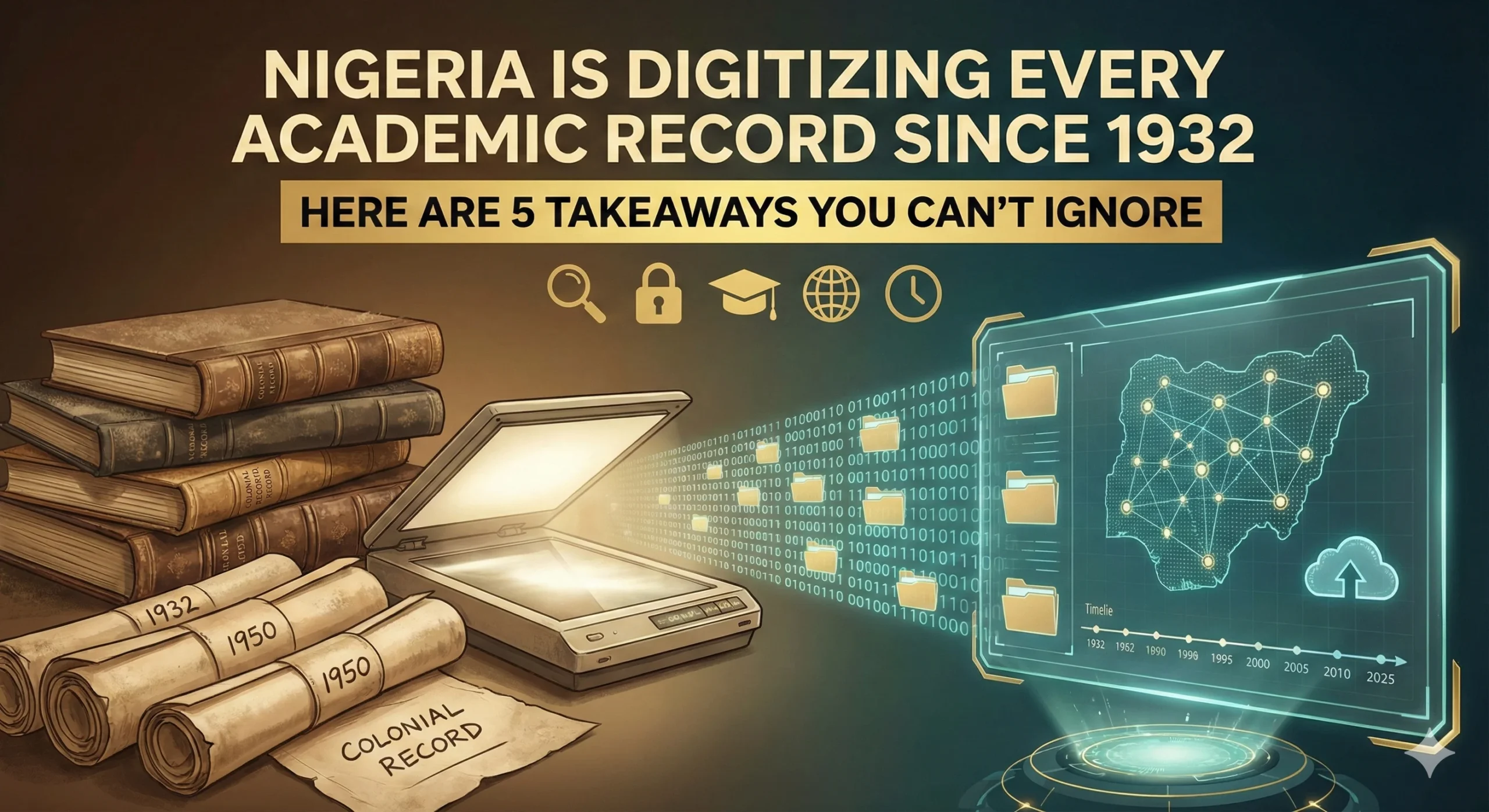
Now, the Nigerian government has activated a policy designed to permanently excise these frustrations from the system. Initially approved in 2023 with a forward-looking Declaration of Effectiveness dated February 4th, 2025, the “National Policy for the Nigeria Education Repository and Databank (NERD)” is a sweeping plan to digitize and centralize the country’s entire post-secondary academic output. This policy has surprisingly far-reaching implications, and this article breaks down the five most impactful takeaways for students, academics, and the country at large.
2.0 Takeaway 1: It’s a Digital Time Machine for All Nigerian Knowledge
1. A Digital Library of Everything, Going Back to 1932
The sheer scale and ambition of the NERD project are staggering. It aims to digitize and centrally preserve academic outputs from every post-secondary institution in Nigeria. The scale is not just forward-looking; the policy mandates the historical digitization of records going back to the establishment of the first polytechnic in 1932 and the first university in 1948.
The project targets a comprehensive range of academic work, including “final year project reports, theses and dissertations… seminar papers, term papers, [and] teaching practice reports.” A primary goal is to prevent crucial research from being lost, a problem that has plagued the nation’s intellectual history for decades. By creating a single, unified “National Repository of Knowledge,” the policy seeks to preserve the country’s intellectual heritage for future generations, ensuring that valuable insights are never again misplaced or forgotten.
This remains the most audacious attempt ever to aggregate all records and knowledge, past and present, ever produced or generated in our tertiary institutions and post-secondary schools.
3.0 Takeaway 2: The End of “Arrangee” Degrees and Plagiarism
2. A Systemic Crackdown on Academic Fraud
A central objective of the NERD policy is to launch a decisive attack on academic fraud. The initiative explicitly targets the “merchants of fake degrees, ‘arrangee’ qualifications, phoney certificates, bogus unearned honours from unaccredited institutions and diploma mills.” To achieve this, the policy introduces several powerful, interconnected mechanisms:
- Mandatory Plagiarism Checks: Every student’s academic output—from term papers to dissertations—must be deposited into the national repository after undergoing a mandatory anti-plagiarism and similarity check.
- Biometric Identity Verification: The entire system will be biometric-enabled, leveraging the National Identification Number (NIN) and Bank Verification Number (BVN) to create a unique, verifiable profile for every student.
- Instant Certificate Validation: All certificates issued by Nigerian schools will now feature unobtrusive micro FrameQR codes, allowing for instant validation through the new National Credential Management and Verification Centre.
What’s truly disruptive here is the synthesis of these tools. By linking a student’s biometric data (NIN/BVN) to every piece of their academic work via a national database, the system creates a permanent, unforgeable “academic footprint.” This isn’t just about catching cheaters; it’s about making academic identity as unique and verifiable as a fingerprint.
4.0 Takeaway 3: No NERD Compliance, No NYSC Mobilization
3. Compliance Isn’t Optional—It’s Tied to NYSC
Here is the policy’s sharpest edge: for graduates, NERD compliance is not optional. It is now a mandatory gateway to the National Youth Service Corps (NYSC). The official declaration leaves no room for ambiguity and also applies to the Industrial Training Fund (ITF) for students submitting SIWES reports.
…the National Youth Service Corps (likewise the Industrial Training Fund) shall, following this declaration, mobilize, exempt, or refund only students who have fully complied with the NERD standard as defined in the approved regulations enshrined in the NERD Policy regardless of whether they had their education experience within or outside Nigeria.
The final phrase is game-changing. It dramatically expands the policy’s scope by implying that Nigerians who study abroad and wish to participate in NYSC must also have their credentials validated through this system. This powerful enforcement mechanism not only ensures universal participation within Nigeria but also extends its reach globally, positioning NERD as the single, authoritative validator of Nigerian academic credentials worldwide.
5.0 Takeaway 4: Nigeria is Building Its Own Alternative to SCOPUS
4. A “Made in Nigeria” Index for Academic Prestige
This move signals a strategic pivot towards academic nationalism. The policy directly confronts the financial challenges and capital flight associated with publishing in high-impact foreign journals indexed in databases like SCOPUS. The source document calls NERD’s solution a “deliberate mitigation strategy.”
The solution is to build a homegrown alternative. The NERD system will create, host, and administer the “Special Nigeria (National) Indexes of Academic Publications (SNIAP).” The government has designated these SNIAP-indexed journals as a “credible national equivalent” to foreign indexes. Crucially, publications in these journals will now be acceptable for promotions and career advancement for academics across all Nigerian tertiary institutions. The underlying logic is clear: to build a self-reliant intellectual ecosystem and enhance the prestige and influence of Nigerian-led research on its own terms.
6.0 Takeaway 5: It’s a Private-Sector Project to Reclaim National Pride
5. It’s a Commercial Venture to Boost National Pride and Security
Perhaps the most surprising aspect of this massive national project is its funding model. This is not a typical government-funded initiative. The policy framework establishes NERD as a “private-sector-led big data project,” which will be financed, executed, and managed “wholly by the private sector without any financial contribution from the government.” This is a radical approach for a national infrastructure project of this magnitude in Nigeria and a key strategic innovation in itself.
This model is explicitly linked to the theme of data sovereignty. The policy document notes that for decades, Nigeria relied on “foreign countries and overseas business corporations for the organization and preservation of her academic records,” a situation that “undermined national security, eroded national pride, and promoted capital flight.” The NERD project is explicitly designed to reverse this by giving Nigeria “organic control of its data and its stacks of knowledge in its strategic national interest.”
7.0 Conclusion: A New Foundation for Knowledge
The National Education Repository and Databank is far more than a digital archive. It represents a foundational shift in how Nigeria manages, verifies, and values its intellectual output. It’s simultaneously a historical preservation tool, a fraud-prevention engine, a catalyst for academic independence, and a radical new model for public-private partnership in building national infrastructure. By tackling everything from historical preservation to data sovereignty, the NERD policy is laying down a new, transparent, and secure foundation for the nation’s knowledge economy.
As Nigeria digitizes its entire intellectual history and puts it at the nation’s fingertips, what new innovations and discoveries will this foundation make possible for the next generation?





Leave a comment