

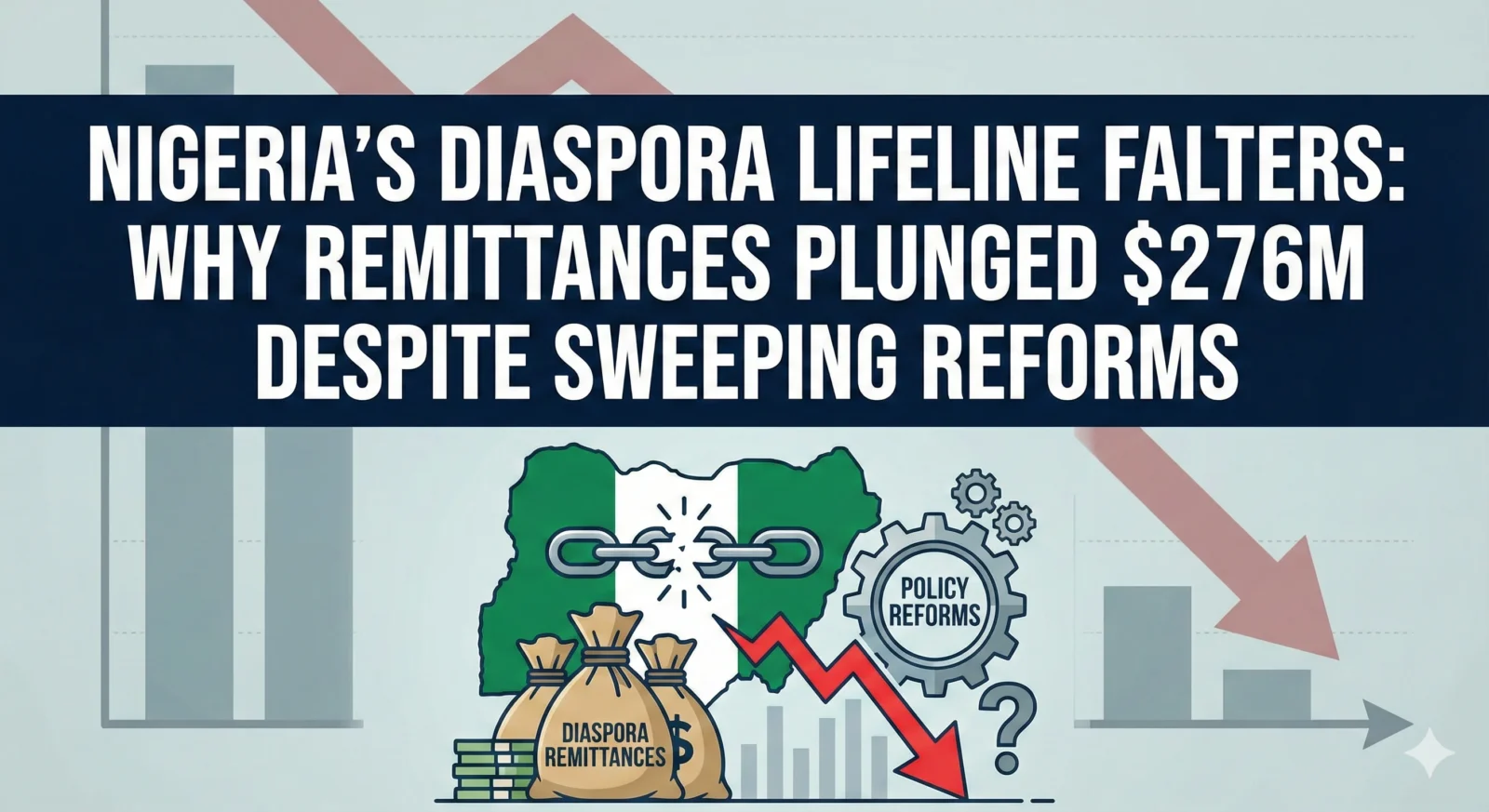
Remittances from the Nigerian diaspora are far more than a private source of family support; they are a core pillar of the Central Bank of Nigeria’s (CBN) strategy to stabilize the Naira and improve market liquidity. For years, this vital flow of foreign exchange has provided a crucial buffer against volatile oil earnings. With monetary authorities banking on these inflows to support the economy, the latest data creates a counterintuitive and concerning narrative for policymakers. Check Economic Briefing: Analysis of Nigerian Remittance Inflows and Policy Landscape in H1 2025
Despite a concerted policy push to boost diaspora dollars, figures for the first half of 2025 show a surprising and significant decline. This article unpacks the most surprising takeaways from the data, revealing a complex picture of economic headwinds, policy paradoxes, and unexpected bright spots.
A Quarter-Billion Dollar Drop, Despite Major Reforms
The top-line finding is stark: in the first six months of 2025, remittance inflows through International Money Transfer Operators (IMTOs) fell by $275.93 million, an 11.78% decrease compared to the same period in 2024.
The specific figures show that inflows totaled 2.07 billion in H1 2025, a significant drop from the 2.34 billion recorded in H1 2024. This decline is particularly impactful because it occurred precisely when the CBN was rolling out aggressive reforms designed to increase foreign exchange inflows, suggesting that the CBN’s policy arsenal, while significant, has so far been insufficient to shield this vital source of FX from powerful macroeconomic headwinds.
The Curious Case of the April Spike
While five of the six months in the first half of 2025 saw significant year-on-year declines, the month of April bucked the trend in a spectacular fashion.
Inflows for April 2025 rose sharply by 28.18% year-on-year, jumping from 466.11 million in April 2024 to 597.44 million. This was the strongest performance in the entire six-month period and the only month to record positive growth. This single positive month was so strong that it helped moderate the overall six-month decline. It serves as a critical reminder that the factors influencing remittance behavior are complex and not uniformly negative.
The Paradox of Sweeping Policy Changes
Over the past year, the CBN has undertaken a series of ambitious reforms aimed at stabilizing the foreign exchange market and boosting confidence in the remittance sector. The CBN’s strategy was two-pronged: simultaneously raising the barrier to entry to ensure market stability while liberalizing market mechanics to encourage greater inflows. These actions include:
- Removing the cap on exchange rates quoted by IMTOs, allowing for more market-driven pricing.
- Increasing the IMTO license application fee by nearly 1,900%, from N500,000 to N10 million.
- Establishing a $1 million minimum operating capital requirement for IMTOs.
- Creating a special task force under the CBN Governor with the explicit goal of doubling remittance inflows.
- Granting 14 new IMTO licenses to increase market competition.
- Lifting the restriction that barred IMTOs from purchasing foreign exchange from the domestic market, allowing them to trade on the official market.
The paradox is that these significant reforms, which likely fueled growth in 2024, have not been enough to sustain that momentum into 2025. This indicates that deeper economic headwinds are shaping the decisions of the diaspora.
The Bigger Picture – An “Uneven” and Sensitive Lifeline
The monthly data reveals just how volatile this source of foreign exchange can be. The period was marked by extreme volatility, with five of six months posting double-digit declines including drops of 27.86% in January and 28.80% in May, interrupted by the anomalous 28.18% surge in April. This volatility underscores the challenge of relying on this financial channel.
As the CBN’s own data suggests, the flow of remittances is anything but steady.
“…the remittance pipeline remains uneven.”
This sensitivity is likely driven by a combination of factors, including fluctuations in the FX market, changing global economic conditions, and the shifting domestic purchasing power of the Naira, all of which influence when and how much money Nigerians abroad choose to send home.
A Puzzle for Nigeria’s Economy
A critical pillar of Nigeria’s non-oil FX strategy is underperforming at the very moment it’s needed most. The story of remittances in 2025 is not one of simple failure but of complexity. The overall decline is a cause for concern, yet bright spots like the April spike offer a compelling counter-narrative, suggesting that under the right conditions, growth is still possible.
As Nigeria navigates these economic headwinds, is the April surge a replicable success story or just a fleeting anomaly in a challenging trend?



Leave a comment