

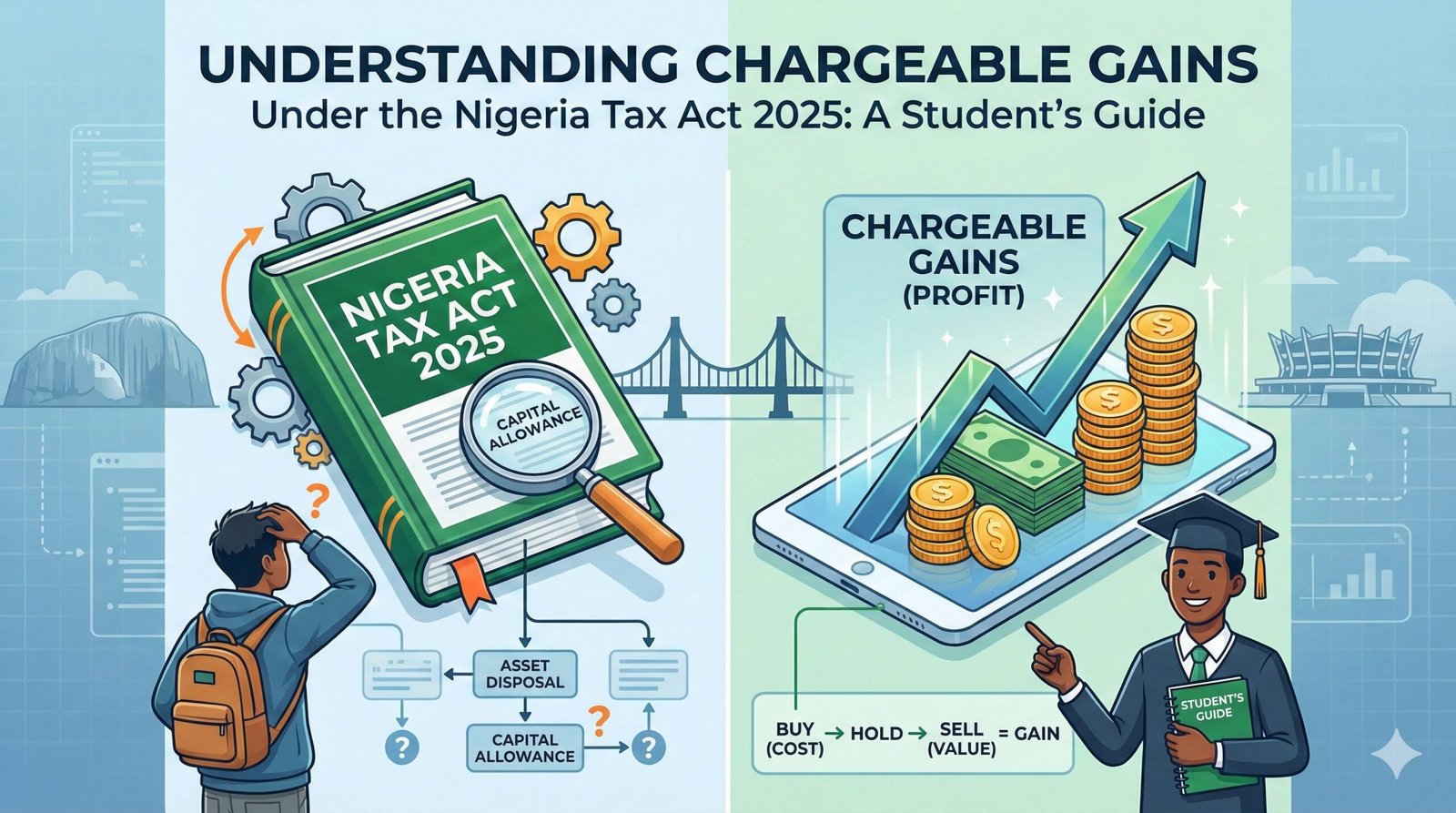
Welcome, future tax professionals. One of the fundamental areas of Nigerian tax law is understanding how gains from the disposal of assets are treated. According to Section 33 of the Nigeria Tax Act 2025, any gain that accrues to a person or company from disposing of certain assets is chargeable to tax. Read the Step-by-Step Guide to Obtain Tax ID.
This “chargeable gain” is a key component of a taxpayer’s total income. For companies, it is included in the calculation of their total profits (Section 27(1)), and for individuals, it forms part of their taxable income (Section 28(2)(a)(v)).
The purpose of this guide is to provide a clear, step-by-step breakdown of how these gains are calculated, specifically for students of Nigerian tax law. To fully grasp the calculation, we must first understand the core concepts: what assets are taxable and what activities count as a disposal.
1. The Building Blocks: Key Concepts Explained
Let’s begin by defining the essential terms used in the Act.
1.1. What is a “Chargeable Asset”?
Under Section 34, the term “chargeable asset” is very broad and includes almost all forms of property, whether they are located in Nigeria or not. Key examples include:
- Financial Assets: Shares, options, rights, and debts.
- Digital or Virtual Assets: This modern category ensures that gains from assets like cryptocurrencies are covered.
- Foreign Currency: Any currency other than the Nigerian Naira.
- Incorporeal Property: Intangible assets like intellectual property (e.g., copyrights, patents) and legal rights.
The Act provides a significant exemption for gains made from selling shares in a Nigerian company. Under the proviso in Section 34(1)(a), such a gain is not a chargeable gain if the following conditions are met:
- The total disposal proceeds are less than N150,000,000 and the resulting chargeable gain does not exceed N10,000,000 in any 12-month period.
- The proceeds are reinvested within the same year of assessment into acquiring shares in the same or another Nigerian company.
If only a portion of the proceeds is reinvested, the tax will apply proportionately to the part that was not reinvested.
1.2. What Qualifies as a “Disposal”?
The term “disposal” is not limited to a simple sale. Section 35 of the Act defines it broadly to cover any situation where a sum of money or value is derived from an asset.
The following are key examples of what constitutes a disposal:
- A sale, lease, transfer, or assignment of an asset.
- A compulsory acquisition of an asset by a government authority.
- Receiving compensation for the loss, damage, or depreciation of an asset (for instance, an insurance payout after an asset is destroyed).
- Receiving a payment in return for giving up or surrendering a right.
It is also important to understand the concept of a “part disposal.” As defined in Section 35(3)(b), a part disposal occurs when you dispose of an interest or right in an asset, but still retain some part of the original interest in that property.
Now that we have established the foundational concepts of what constitutes a chargeable asset and a disposal, we can proceed to the core calculation itself.
2. The Core Calculation: How to Determine Chargeable Gains
The fundamental formula for calculating chargeable gains is straightforward:
Chargeable Gain = Disposal Proceeds – Allowable Costs
However, Section 39 of the Act specifies that the exact “Allowable Costs” you can deduct depend on a critical factor: whether capital allowances have been claimed on the asset in the past.
2.1. Step 1: Determine the Disposal Proceeds
This is the starting point of your calculation. Typically, the disposal proceeds are simply the amount of money or value received from the disposal.
However, the law recognizes that not all transactions happen at a fair price, especially between connected parties. Under Section 36, in certain circumstances, you must use the market value of the asset as the disposal proceeds, regardless of the actual price paid.
The Act defines “market value” in Section 45(1) as the price the asset might reasonably be expected to fetch in an open market sale between a willing buyer and a willing seller who are independent and acting at arm’s length.
The table below, based on Section 36(1), clarifies when to use the actual consideration versus the market value.
| When to Use This Value | Scenario Example from the Act |
| Actual Consideration | A normal, arm’s length sale between unconnected parties. |
| Market Value | The transaction is not at arm’s length (e.g., between connected persons). |
| Market Value | The consideration received cannot be valued in money. |
| Market Value | The asset is acquired as a trustee for the creditors of the person disposing of it. |
2.2. Step 2: Determine the Allowable Costs
This step involves identifying the correct cost basis of the asset to deduct from the disposal proceeds. The Act provides two distinct methods based on whether capital allowances were previously claimed on the asset.
For Assets where NO Capital Allowance was Claimed:
- According to Section 39(b), the allowable cost is the
amount or value of the considerationused to acquire the asset. In simple terms, this is the original purchase price of the asset.
For Assets where Capital Allowance WAS Claimed:
- According to Section 39(a), the allowable cost is the
residue of that asset. The “residue” is the original cost of the asset minus the total capital allowances that have been claimed on it over its lifetime. This is also commonly known as the tax written-down value.
2.3. Step 3: Deduct Incidental Costs
Finally, Section 40 allows for an additional deduction. Any incidental costs that were incurred wholly and exclusively for the purpose of making the disposal can be subtracted from the disposal proceeds.
Simple examples of such costs include:
- Legal fees paid to a lawyer to handle the sale contract.
- A valuer’s fee paid to determine the market value of the asset for the sale.
While this three-step process covers the standard calculation, the Act includes important rules for special situations and offers generous exemptions that every tax student must be aware of.
3. Important Nuances and Exemptions
The tax law is not a one-size-fits-all instrument. It provides specific rules for complex situations like part disposals and exempts certain gains entirely, particularly for individuals.
3.1. Special Case: Part Disposals
When only a part of an asset is sold, you cannot deduct the entire acquisition cost. Instead, the cost must be fairly apportioned between the part that was sold and the part that was retained. Section 41 provides a specific formula for this apportionment.
First, identify the two key values as defined in Section 41(2):
- A = The consideration received for the part being disposed of.
- B = The market value of the part that remains undisposed.
Then, use the apportionment formula from Section 41(3) to find the portion of the cost that can be deducted:
Formula for Apportioned Cost = Total Acquisition Cost x [A / (A + B)]
3.2. Three Key Exemptions for Individuals
The Act provides several exemptions, but the following three are particularly important for individuals as they apply to common life events.
- Principal Private Residences Based on Section 51, any gain an individual makes from selling their main home (a dwelling-house or part of one) is exempt from tax. This is a significant relief, but it is a once-in-a-lifetime exemption. It ensures that individuals are not taxed on the appreciation of their primary residence.
- Personal Belongings (Chattels) Under Section 52, gains from selling tangible movable property—often called “chattels”—are not chargeable if the total consideration received for all such disposals in a year of assessment is less than N5,000,000 or three times the annual national minimum wage, whichever is higher. This covers items like furniture, art, or personal effects, exempting small-scale sales from tax.
- Private Motor Vehicles Section 53 states that a motor vehicle used solely for private purposes is not considered a chargeable asset. This means any gain you make from selling your personal car is completely exempt from tax. The Act limits this exemption to a maximum of two such vehicles per individual in any year of assessment.
With these calculations and exemptions in mind, we can now summarize the most critical points.
4. Conclusion: Key Takeaways
As a student of Nigerian tax law, understanding the calculation of chargeable gains is crucial. Here are the three most important takeaways from this guide:
- Gains are calculated on the disposal of nearly all assets, not just land and buildings. The definition is broad and includes shares, foreign currencies, and even digital assets.
- The core formula is
Proceeds - Costs, but the specific type of ‘cost’ you can deduct depends entirely on whether capital allowances were previously claimed. The correct cost is either the original acquisition cost or the asset’s residue (tax written-down value). - Significant exemptions exist, especially for an individual’s main home, personal belongings (up to a threshold of N5,000,000 or three times the minimum wage, whichever is higher), and private vehicles. These exemptions can remove the tax liability entirely in many common situations.






1 Comment