

Welcome to this guide on the organizational structure of Nigeria’s National Agency for Food and Drug Administration and Control (NAFDAC). This document’s purpose is to clearly and simply explain how NAFDAC is structured, based on its founding Act. As stated in the Act’s preamble, NAFDAC is the body established to regulate and control products like food, drugs, cosmetics, medical devices, bottled water, and chemicals. Understanding how this vital agency is organized is the first step to appreciating its role in public health, and with this guide, you’ll find it’s quite straightforward.
Read on NAFDAC Officer’s Operational Handbook: Powers, Procedures, and Protocols.
Download and Read NAFDAC Act The Legal Blueprint
1. NAFDAC’s Leadership: The Two Core Pillars
NAFDAC’s leadership is built on two main parts: a strategic governing body that sets the direction and an executive leader who manages the daily operations.
1.1 The Governing Council: The Strategic Overseers
The Governing Council is the primary body responsible for the strategic direction and policy oversight of the Agency. According to Section 6 of the Act, its most important functions for a learner to understand are:
- Advising the government on national policies related to food and drug control.
- Designating quality specifications that regulated products must meet to be certified.
- Appoint, promote, and discipline the Agency’s employees.
The composition of the Governing Council, as outlined in Section 2 of the Act, brings together a wide range of expertise:
| Position/Role | Description |
| Chairman | Appointed by the President on the Minister’s recommendation. |
| Permanent Secretary, Federal Ministry of Health | Representative from the Ministry of Health. |
| Director & Chief Executive, Nat’l Inst. for Pharmaceutical Research | Representative from the National Institute for Pharmaceutical Research and Development. |
| Director-General, Standards Organisation of Nigeria | Representative from the Standards Organisation of Nigeria. |
| Chairman, National Drug Law Enforcement Agency (NDLEA) | Representative from the NDLEA. |
| Chairman, Pharmacists Board of Nigeria | Representative from the Pharmacists Board of Nigeria. |
| Representative, Pharmaceutical Group of MAN | One person representing the Pharmaceutical Group of the Manufacturers Association of Nigeria. |
| Representative, Food & Beverages Group of MAN | One person representing the Food Beverages Group of the Manufacturers Association of Nigeria. |
| Director-General, NAFDAC | The Director-General of the Agency itself. |
| Public Interest Representatives (3) | Three persons appointed by the Minister to represent the public interest. |
This diverse membership ensures that expertise from government, industry, and the public is included in the Agency’s oversight function.
1.2 The Director-General: The Chief Executive
The Director-General is the head of the Agency’s day-to-day operations. According to Section 9 of the Act, the Director-General’s primary roles are:
- Chief Executive: The top operational leader of the Agency.
- Day-to-Day Administrator: Responsible for the daily management and execution of the Agency’s functions.
- Accountable to the Council: Works under the supervision and control of the chairman and the Governing Council.
The Director-General is appointed by the President and is required to be a person with good knowledge of pharmacy, food, and drugs.
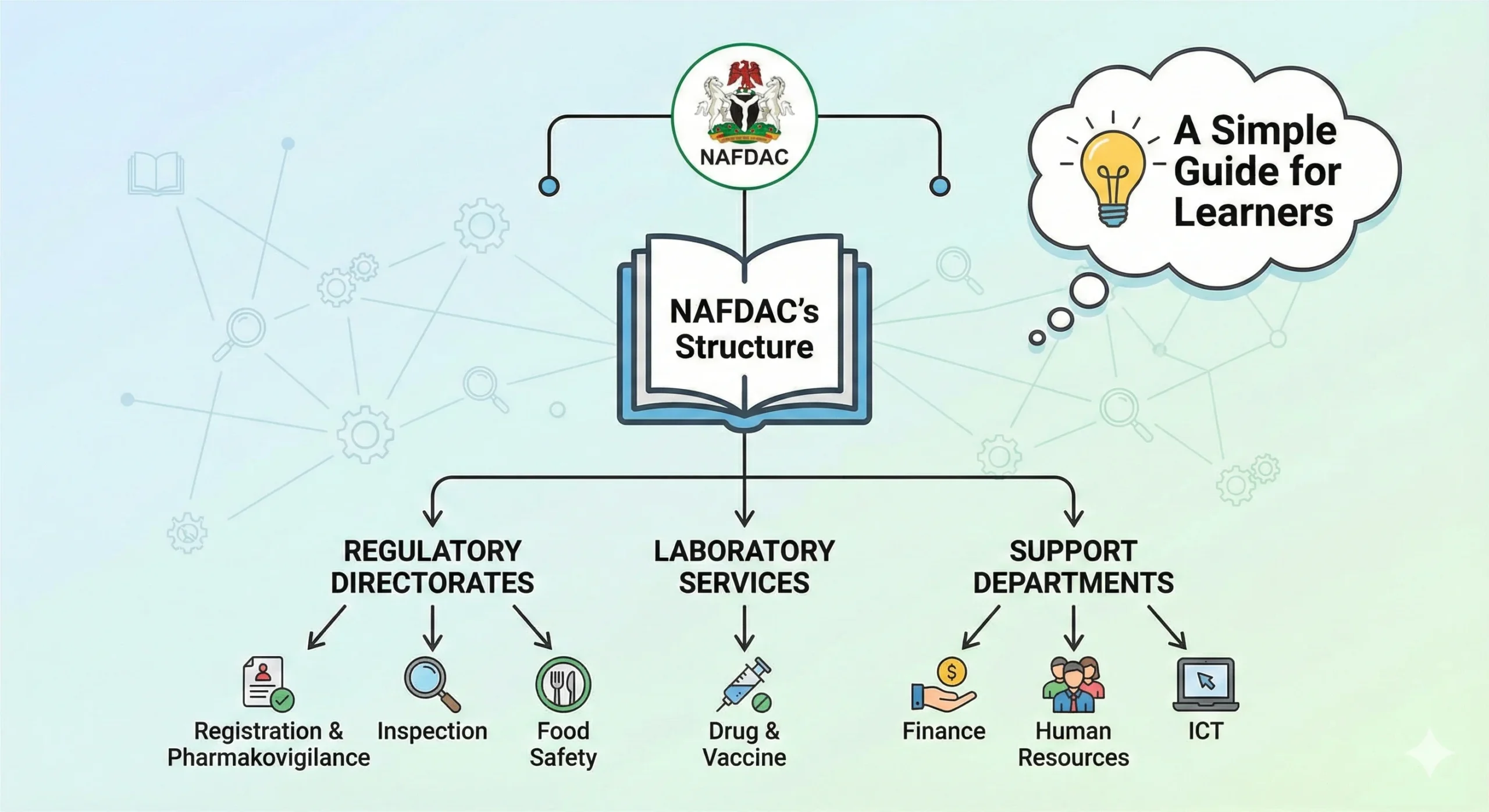
With the leadership framework established, let’s look at the departments, known as Directorates, that perform the Agency’s core functions.
2. The Engine Room: NAFDAC’s Directorates
According to Section 8 of the Act, the Agency is structured into several key departments called Directorates, each with a specific focus. The Act explicitly names six foundational Directorates:
- Administration and Finance Directorate: Manages the agency’s internal administration, finances, and serves as the secretary.
- Planning, Research and Statistics Directorate: Handles strategic planning, research initiatives, and data management.
- Narcotics and Controlled Substances Directorate: Focuses on the regulation of narcotic drugs and other controlled substances.
- Regulatory and Registration Directorate: Manages the processes for registering products like food and drugs.
- Inspectorate Directorate: Conducts inspections of facilities and products to ensure compliance.
- Laboratory Services Directorate: Carries out the scientific testing and analysis of products.
The Act also allows for other Directorates to be created as needed to support the Agency’s mission.
These Directorates are powered by a dedicated team of professionals who make the Agency’s mission a reality.
3. Understanding the Hierarchy: How It All Fits Together
The NAFDAC Act establishes a clear chain of command and responsibility to ensure proper governance and function. This flow of authority can be understood as follows:
- The President: Appoints the Governing Council Chairman and the Director-General, holding the ultimate authority for top leadership appointments.
- The Minister of Health: Recommends the Director-General and Chairman to the President. The Minister also has the power to give general or special directives to the Agency on how it performs its functions (Section 28).
- The Governing Council: Acts as the board of directors. It advises the government, sets policies for the agency, and supervises the Director-General.
- The Director-General: As the chief executive, this individual runs the Agency and its Directorates, reporting directly to the Governing Council.
- The Directorates: These are the operational arms of the Agency, carrying out the specific functions under the leadership of the Director-General.
This clear structure allows NAFDAC to effectively carry out its vital role in protecting public health.
4. Conclusion: A Structure for Public Safety
In summary, NAFDAC’s structure is built on three key pillars: the strategic Governing Council, the executive Director-General, and the functional Directorates. This organizational framework is deliberately designed to ensure that NAFDAC can effectively regulate food, drugs, and other critical products for the safety and well-being of the public. A well-defined structure is essential for accountability, efficiency, and success in its mission to safeguard the health of the nation.






Leave a comment