

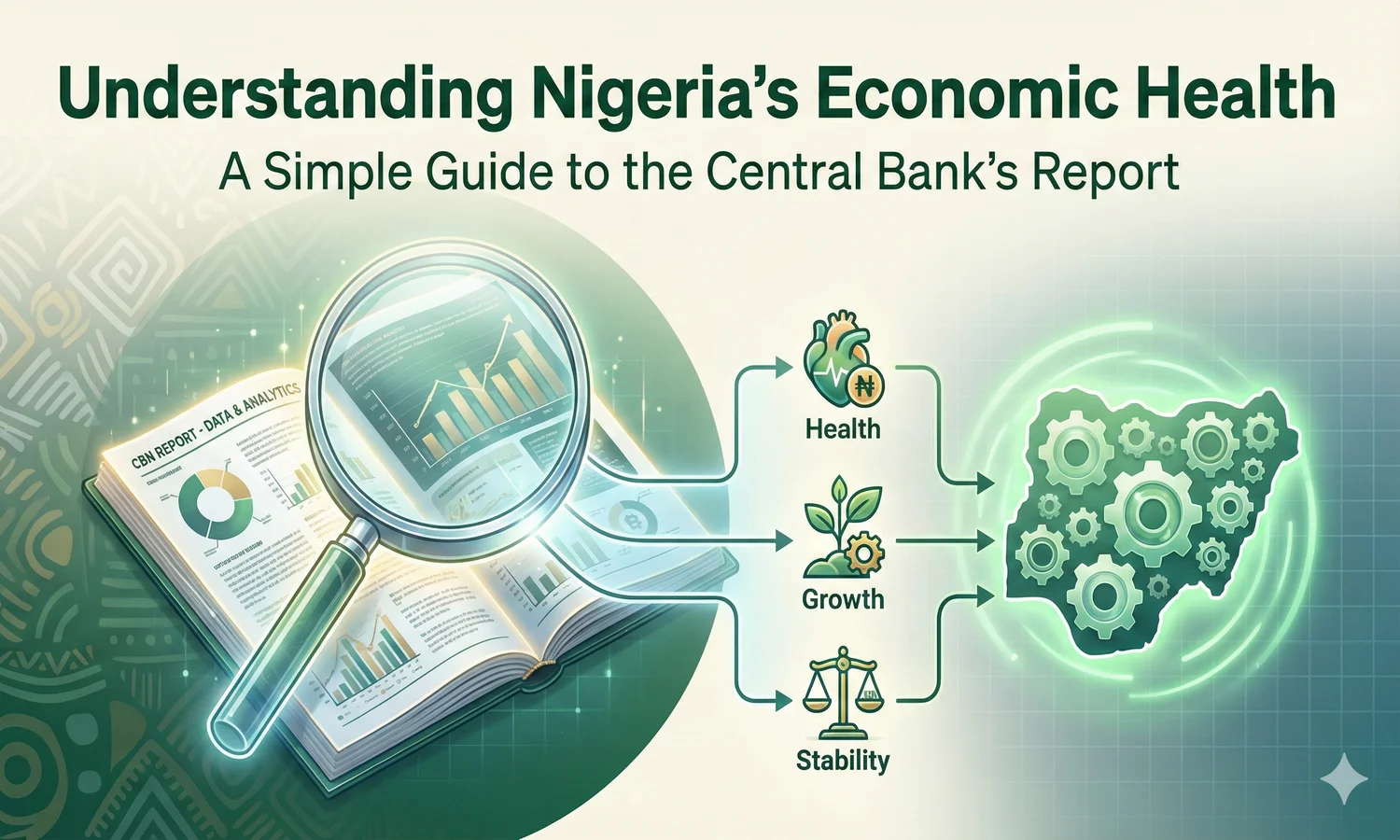
Have you ever wondered how we know if a country’s economy is healthy or sick? Just like a person gets a regular check-up, a country’s economy undergoes constant monitoring. In Nigeria, the primary “economic doctors” are the Central Bank of Nigeria (CBN) and its Monetary Policy Committee (MPC).
MPC_Decision_and_Economic_OutlookThis guide will break down their latest “health report”—the MPC Communiqué—into simple terms. We’ll look at the key decisions, explain the big words, and see what it all means for the country’s financial well-being.
1. The Main Decision: What Did the ‘Doctors’ Decide?
The most important decision made by the MPC was to keep the main interest rate, the Monetary Policy Rate (MPR), unchanged at 27.0%.
The Monetary Policy Rate (MPR) is the benchmark interest rate set by the Central Bank. It acts as an anchor that influences all other interest rates in the economy, from the loans commercial banks give each other to the rates you see on savings accounts and business loans.
Think of the MPR as the main lever the Central Bank uses to control the speed of the economy. Raising it is like tapping the brakes to slow things down (especially rising prices), while lowering it is like hitting the gas to speed things up.
The CBN decided to keep its foot steady on the brake—but not press any harder—to “sustain the progress made so far towards achieving low and stable inflation.” In other words, they believe their past actions are working and want to give them more time to take full effect. Along with this main decision, the committee also kept other key financial regulations, like the Cash Reserve Requirement, stable to maintain consistency in its policy. Read on Nigeria Just Hit Reset on a Decade of Cash Policy: Here’s What Matters.
Now, let’s look at the key ‘vital signs’ the economic doctors reviewed to make this important decision.
2. The Vital Signs: Key Economic Indicators Explained
Just like a doctor checks your temperature and blood pressure, the CBN checks specific economic indicators to assess the country’s health. Here are the three most important ones from their report.
2.1. Indicator #1: Inflation (The Speed of Price Changes)
Inflation is the measure of how quickly the price of everyday items—like a loaf of bread or a bus ticket—is increasing over time. High inflation means your money buys less than it used to.
The report shared very positive news about inflation:
- What’s Happening? Headline inflation is slowing down.
- The Latest Number: It fell to 16.05% in October 2025, a significant drop from 18.02% in September.
- The Trend: This is the 7th month in a row that the speed of price increases has decreased.
- Good News on Food: Food inflation also dropped significantly to 13.12% from 16.87% the previous month.
So what does this mean? This is excellent news. While prices are still rising, they are not rising as fast as before. This slowdown isn’t just because of the Central Bank’s past decisions. The report points to several factors working together: a stable exchange rate making imported goods less expensive, more foreign investment coming into Nigeria, improved food supply from harvests, and stable fuel prices.
Connecting to the Decision: This slowing inflation is a key reason the MPC felt confident in holding interest rates steady. It’s a strong signal that their policy of “tapping the brakes,” combined with other positive economic factors, has been effective.
2.2. Indicator #2: Gross Domestic Product (GDP) (The Economy’s Total Score)
Real Gross Domestic Product (GDP) is the total value of everything made and all services provided in a country over a specific period. Think of it as a giant report card for the economy’s performance.
The report shows that the economy is performing well. The economy grew by 4.23% in the second quarter of 2025, which is an improvement from the first quarter’s growth of 3.13%.
So what does this mean? This is positive news. A growing GDP suggests the economy is expanding, which can lead to more jobs and business opportunities. Adding to this, a forward-looking survey called the Purchasing Manager’s Index (PMI) rose to 56.4 points, its highest level in five years. This is important because it shows that business leaders are optimistic about the future, which suggests growth is likely to continue.
Connecting to the Decision: This robust economic growth gave the CBN confidence that its existing tight monetary policy—the ‘foot on the brake’—was successfully fighting inflation without unduly harming the country’s overall economic output.
2.3. Indicator #3: External Reserves (The Nation’s Savings Account)
Gross External Reserves can be thought of as Nigeria’s national savings account, holding foreign currencies like U.S. dollars. This account is crucial for paying for things the country imports and for keeping the value of the Nigerian Naira stable.
The report shows this savings account is in excellent shape:
- What’s Happening? The reserves are growing.
- The Latest Amount: They reached US$46.70 billion.
- The ‘Safety Net’: This is enough money to cover the cost of all Nigerian imports for 10.3 months.
So what does this mean? This is very good news because it boosts international confidence. In fact, the report noted that this strong performance contributed to major agencies upgrading Nigeria’s sovereign credit rating and the country being removed from the international ‘grey list’ for financial monitoring (the FATF list). These are like getting a gold star from the international community, making Nigeria a more attractive place for investors.
Connecting to the Decision: The report makes a direct connection here. These strong reserves are a key reason why the exchange rate has been stable. A stable Naira helps slow down the inflation of imported goods. This created a positive feedback loop—strong reserves support a stable currency, which in turn helps bring down inflation, reinforcing the MPC’s decision to stay the course.
Seeing these vital signs individually is helpful, but the real story comes from seeing how they all fit together.
3. Putting It All Together: The Full Picture
By looking at these three indicators, we can create a single narrative about the economy’s health. The MPC saw positive trends across the board.
Here is a simple “Economic Health Report Card” summarizing their findings:
| Vital Sign | What It Measures | The Trend (Good/Bad News) |
| Inflation | The speed of price increases | Good News: It’s slowing down. |
| GDP | The growth of the economy | Good News: It’s growing steadily. |
| External Reserves | The nation’s foreign savings | Good News: They are increasing. |
The combined story is clear: With inflation cooling down, the economy growing, and the national savings account looking healthy, the CBN decided the best course of action was to hold steady. They concluded that the “medicine” is already working, and it’s best to let it continue its job without changing the prescription.
4. Conclusion: Your Economic Snapshot
By breaking down the official report, we get a clear picture of Nigeria’s economic health. Here are the key takeaways:
- The Central Bank of Nigeria decided to keep its main interest rate (MPR) at 27.0%.
- They made this decision because key economic signs—like slowing inflation, growing GDP, and rising external reserves—are all positive.
- This ‘wait-and-see’ approach is intended to continue fighting inflation without slowing down the healthy parts of the economy.
Understanding these core concepts is the first step to making sense of the economic news you hear every day and how it affects you, your family, and the entire country.





Leave a comment