

A Bureau De Change (BDC) is a business that helps people exchange one currency for another. Read Executive Summary: Financial and Operational Impact of New CBN BDC Licensing Framework.
Recently, the Central Bank of Nigeria (CBN) introduced a new set of rules for these businesses. The goal of these reforms is to strengthen Nigeria’s foreign exchange market and make it more reliable for everyone. The three primary objectives are:
- To improve public access to foreign currency for retail users.
- To make BDC businesses financially stronger and more sustainable.
- To help stop illegal financial activities like money laundering.
To achieve these goals, the CBN has introduced a new two-tier structure, with stricter financial requirements designed to create more robust and transparent operators.
2.0 The Two Tiers of BDCs Explained
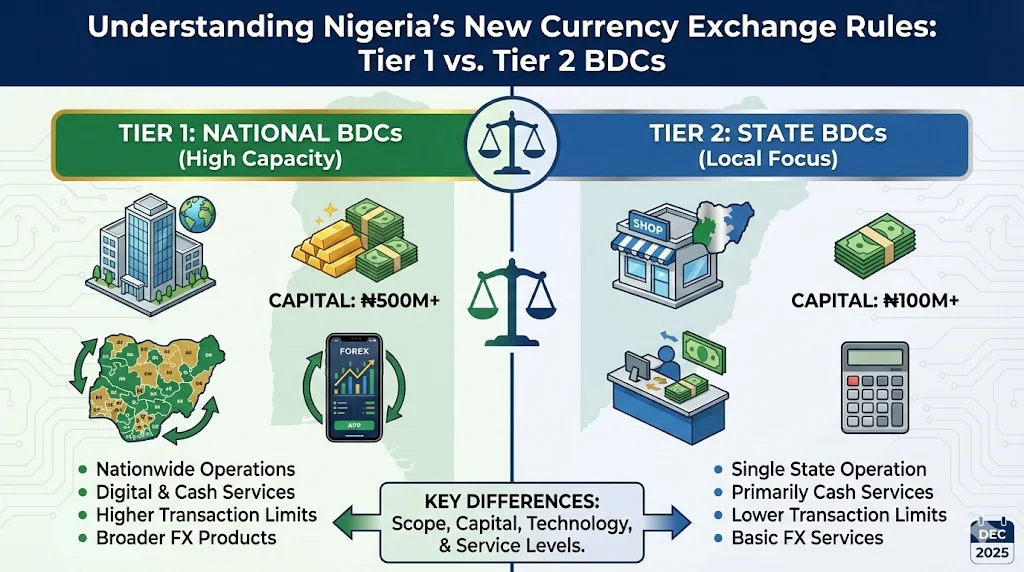
The CBN has divided all BDC operators into two distinct categories: Tier 1 and Tier 2. The main differences between them relate to the amount of money they need to start, the fees they must pay, and where they are allowed to operate.
The table below provides a clear comparison based on the new guidelines.
| Feature | Tier 1 Operators | Tier 2 Operators |
| Minimum Capital Needed | N2 billion | N500 million |
| Application Fee | N1 million (Non-refundable) | N250,000 (Non-refundable) |
| Licence Fee | N5 million (Non-refundable) | N2 million (Non-refundable) |
| Where They Can Operate | Nationwide | In a single state or the Federal Capital Territory (FCT) |
| Opening Branches | Can open branches and appoint franchisees nationwide, with CBN approval. | Can establish up to five branches within their single state of operation, with CBN consent. |
These structural differences create two very different business models, which affects how and where the public can access their services.
3.0 What Do These Differences Mean in Practice?
For Tier 1 Operators
The key advantage for a Tier 1 operator is its national reach. With the ability to operate across the entire country, open multiple branches, and even appoint franchisees, these businesses are positioned to serve a much larger market. The first two companies licensed as Tier 1 BDCs are:
- Dula Global BDC Ltd
- Trurate Global BDC Ltd
For Tier 2 Operators
A Tier 2 operator is designed to have a more localized focus. These businesses are restricted to operating within a single state or the FCT and can open a maximum of five branches there. This model allows them to serve specific regional or urban communities. The CBN has already licensed 80 Tier 2 operators, including:
- Hazon Capital BDC Ltd
- Travellers Choice BDC Ltd
This two-tiered system aims to meet the public’s need for foreign exchange on both a national scale (through well-capitalized Tier 1 operators) and a local level (through accessible Tier 2 operators), all while increasing financial stability across the market.
4.0 Key Takeaway: Always Use an Approved BDC
The most important point for the public is to ensure you are dealing with a legitimate, licensed currency exchange operator. The CBN strongly advises the public to only use BDCs that are officially licensed and listed on the CBN’s website.
According to Section 57 of the Banks and Other Financial Institutions Act 2020, running a BDC business without a valid licence is a punishable offence. By using only licensed BDCs, you protect your money from fraud and ensure you are not unknowingly participating in an illegal financial transaction.


Leave a comment