

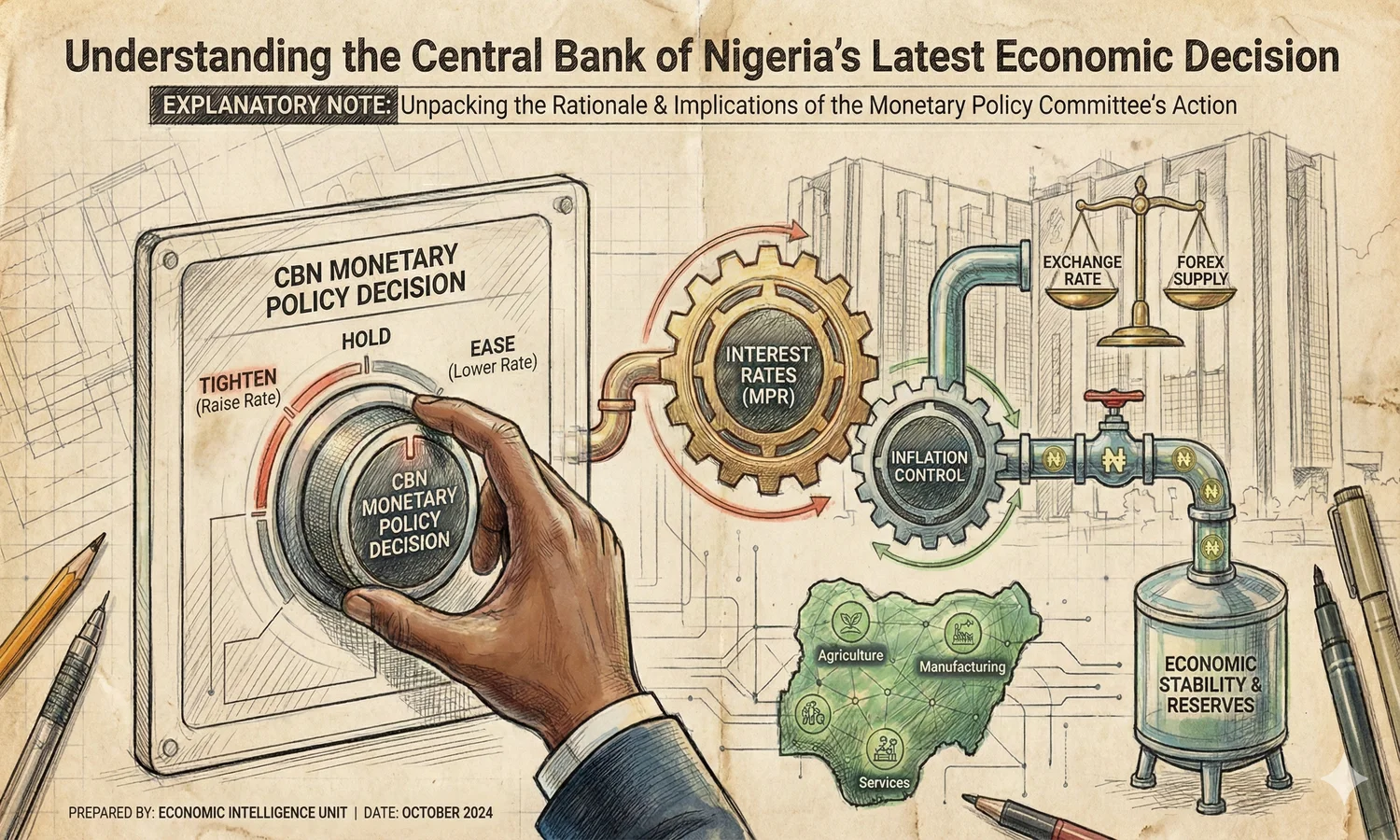
In a move signaling cautious optimism for the Nigerian economy, the Central Bank’s Monetary Policy Committee has opted to hold its key interest rates steady after its latest meeting on November 24-25, 2025. The Monetary Policy Committee (MPC) is the group within the Central Bank of Nigeria (CBN) responsible for setting the country’s most important economic policies, much like a pilot setting the course for an airplane. All twelve members of the committee attended this important meeting. Read Understanding Nigeria’s Economic Health: A Simple Guide to the Central Bank’s Report.
To fully grasp the committee’s actions, it’s essential to first understand the fundamental tools they have at their disposal.
1. The Banker’s Toolkit: Defining the Key Terms
To understand the CBN’s decision, you first need to know the main tools the bank uses to manage the economy. Think of these as the controls and gauges in an economic cockpit.
Monetary Policy Rate (MPR) : This is the main interest rate that the CBN charges commercial banks, which then influences all other interest rates in the economy. Analogy: Think of it as the “master interest rate” that sets the baseline cost of borrowing money for the entire country.
Cash Reserve Requirement (CRR) : This is the percentage of customer deposits that commercial banks must hold in reserve with the CBN and cannot lend out. Analogy: It’s like a mandatory savings account for banks, ensuring they always have enough cash set aside and can’t lend out every single Naira they hold.
Liquidity Ratio : This is the proportion of a bank’s assets that it must keep in a liquid form (like cash) to meet short-term obligations. Analogy: This is a bank’s “emergency cash fund,” making sure it can give depositors their money back on short notice without any delays.
Standing Facility Corridor : This is a channel for banks to borrow from or deposit funds with the CBN overnight, with rates set relative to the main MPR. Analogy: Think of it as the CBN’s ‘overnight loan window’ for banks. If a bank is short on cash at the end of the day, it can borrow from this window at a penalty rate. If it has excess cash, it can deposit it here for a small return. This keeps the banking system stable day-to-day.
Now that we know the tools, let’s look at the specific decisions the committee made about them.
2. The Big Decision: What Did the Committee Actually Do?
The committee’s main decision was to “maintain the current monetary policy stance,” which simply means they chose not to change their main strategy for now. The specific decisions for each tool were as follows:
| Policy Tool | Decision / Rate |
| Monetary Policy Rate (MPR) | Retain at 27.0 per cent |
| Standing Facility Corridor | Adjust around the MPR at +50/-450 basis points |
| Cash Reserve Requirement (CRR) | Retain at 45.00 per cent for Deposit Money Banks (Note: Different rates apply to other financial institutions). |
| Liquidity Ratio | Keep unchanged at 30.00 per cent |
This decision to hold steady leads to the most important question: why did the committee choose to wait instead of making a change?
3. The “Why” Behind the Wait: Reasons for Holding Steady
The single most important reason for the decision was “to sustain the progress made so far towards achieving low and stable inflation.” The committee believes its current strategy is working and wanted to avoid any moves that could disrupt this progress. Their reasoning was based on three key insights:
- Letting Past Actions Work The committee believes that its previous actions—specifically, raising interest rates (policy tightening)—are still working their way through the economy to bring down prices. The committee noted that this progress was supported by other positive factors like a stable exchange rate, a surplus current account balance, and improved food supply. They want to allow the full “lagged impact” of these combined forces to take effect before considering another change.
- Positive Economic Signs The committee pointed to several encouraging signs in the economy that supported their decision to wait and observe. These included a stable exchange rate and an increase in capital flowing into the country. These signs are crucial because a stable exchange rate helps control the cost of imported goods, while strong capital inflows demonstrate investor confidence, both of which support the MPC’s primary goal of taming inflation. The MPC also commended the “collaborative effort of both the fiscal and monetary authorities,” which led to a recent upgrade of Nigeria’s sovereign credit rating and the country’s removal from the FATF grey list, further boosting investor confidence.
- Lingering Global Uncertainty The MPC also noted that there are “lingering global uncertainties.” With potential instability in the world economy, the committee opted for a cautious approach, preferring to maintain stability at home rather than making any sudden changes.
The committee’s confidence in its current stance was supported by several positive data points they reviewed.
4. The Data Behind the Decision: A Stronger Economic Picture
The MPC’s decision was “data-driven” and supported by several positive developments in the Nigerian economy. Here are the key highlights from their economic dashboard:
- Inflation is Falling: Headline inflation, the overall measure of price increases, dropped for the 7th straight month, falling to 16.05% in October 2025, a significant decrease from 18.02% the previous month. The committee also noted that both food and core inflation slowed down.
- The Economy is Growing: The Real Gross Domestic Product (GDP), a key measure of economic output, grew by 4.23% in the second quarter of 2025, a notable improvement from the 3.13% growth seen in the first quarter. Furthermore, the Purchasing Manager’s Index (PMI)—a key indicator of economic health—rose to 56.4 points in November 2025, its highest level in five years, signaling strong confidence in future growth.
- Stronger International Position: Nigeria’s gross external reserves (its stockpile of foreign currency) grew to US$46.70 billion. This strong reserve position is enough to cover 10.3 months of the country’s imports for goods and services.
- Resilient Banking System: The committee expressed satisfaction with the health and resilience of the country’s banking system. It also noted that sixteen (16) banks have already successfully met the revised, higher capital requirements, a sign of financial strength.
With this positive data in hand, the committee also shared its outlook for the near future.
5. What’s Next? The CBN’s Outlook
Looking ahead, the Monetary Policy Committee is optimistic. The committee’s official forecast indicates that it expects a “sustained disinflation,” meaning that the rate of price increases will continue to slow down in the near term.
This positive outlook is based on two main factors:
- The continued impact of previous monetary policy decisions, which are expected to keep cooling down inflation.
- Improved local food supply from the “ongoing seasonal harvest cycle,” which is expected to lead to lower food prices across the country.
As stated by the CBN Governor, Olayemi Cardoso, the committee will continue to take an evidence-based approach to its decisions. The next MPC meeting is scheduled for February 2026. The decision underscores a strategy of ‘watchful waiting,’ as the CBN balances confidence in its past actions with a cautious eye on an uncertain global stage, setting the tone for Nigeria’s economic path into early 2026.




Leave a comment