

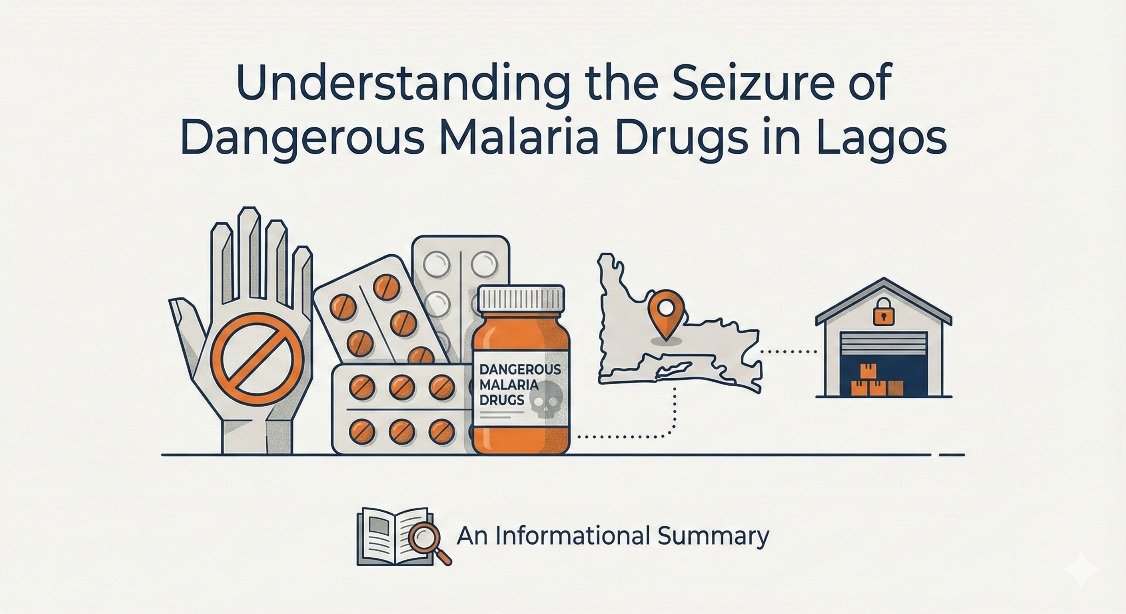
On Christmas Eve, the National Agency for Food, Drug Administration and Control (NAFDAC) conducted a major operation in Ojo, Lagos State, seizing a large quantity of expired malaria drugs. The enforcement action took place at a four-storey building where the expired medications were being illegally repackaged. The operation was hidden in plain sight, with tiles and other building materials stored on one floor to conceal the criminal relabeling of drugs on another. The criminals intended to change the labels on these dangerous products to unleash them onto a public that would be unknowingly consuming ineffective and potentially toxic treatments. Check blog post on More Dangerous Than Terrorism? 3 Shocking Truths from a Fake Drug Bust in Lagos.
2. The Key Players: A Coordinated Effort
The success of this critical public health intervention was the result of several key groups working together. Each played a distinct and vital role in uncovering the crime and stopping the distribution of these harmful drugs.
NAFDAC (The Regulators):As the national agency responsible for drug safety, NAFDAC led the enforcement operation. The team, headed by Dr. Martins Iluyomade, the Director of Investigation and Enforcement, seized the drugs. Speaking on behalf of the Director-General, Dr. Iluyomade stated that relabeling expired drugs is an act of “deliberately harming innocent Nigerians” and called for stricter penalties against the perpetrators.The Local Community (The Whistleblowers):The entire operation was initiated by the vigilance of local residents. Community members were the first to notice suspicious movements around the building and took the crucial step of reporting their concerns to the authorities, acting as essential watchdogs for their neighborhood.Local Government and Police (The Responders):After the community’s report, local authorities responded swiftly. The Ojo Police Station, the Lagos State Commissioner of Police (Olohundare Moshood Jimoh), and the chairman of Ojo local government (Hon. Muhibat Rufai) visited the site to assess the situation. Hon. Rufai praised the residents and urged community associations to continue acting as “watchdogs” for their neighborhoods to ensure the illegal business was halted.
This successful intervention demonstrates a powerful public safety model where community vigilance acts as the first line of defense, enabling law enforcement and regulatory bodies to neutralize threats before they escalate.
3. The Crime Explained: Why Repackaging Expired Drugs is So Harmful
The crime involved taking malaria drugs that had already expired in 2022 and 2024 and relabeling them to deceive consumers into thinking they were safe and effective. This act of fraud poses two significant and life-threatening dangers to public health:
- Deliberate Harm This is not an accident or a minor infraction; it is a conscious and calculated choice to endanger the lives of innocent people for profit. The individuals involved were fully aware that the drugs were expired and potentially toxic.
- Drug Resistance When a person takes substandard medication, it may not be strong enough to kill all the germs causing an illness. The surviving germs can mutate and learn to resist the medicine. This leads to “drug resistance,” meaning that future infections become much harder to treat, not just for that person, but for anyone who catches the resistant strain. This creates a wider public health crisis, as drug-resistant infections can spread, leaving entire communities vulnerable to diseases that were once easily treatable.
NAFDAC’s Director-General, Prof. Mojisola Adeyeye, powerfully summarized the gravity of this crime with a call for equally severe consequences:
“Since these criminals are killing innocent people silently, they should also face the ultimate punishment to serve as a strong deterrent.”
This strong stance reflects the severity of the offense and leads directly to the official calls for harsher punishments.
4. The Official Response: A Call for the Harshest Penalty
In response to this incident, NAFDAC officials have advocated for the most severe punishment possible for those involved in the production, repackaging, or circulation of fake and expired drugs. Both Dr. Martins Iluyomade and Prof. Mojisola Adeyeye have called for capital punishment (the death penalty) for these crimes.
Their justification for this extreme measure is that the actions of these criminals represent a “grave crime against humanity.” They argue that this silent threat is even more dangerous than terrorism because of its widespread, long-term impact on public health.
To formalize this position, a proposal for stricter punishments is already before the National Assembly for consideration. In making their case, officials cited China as an example of a country that executes manufacturers of fake drugs to protect its citizens.
This call for legal reform underscores the agency’s commitment to eradicating this deadly trade, shifting the focus to the broader lessons that can be learned from this incident.
5. Key Takeaways: Lessons in Public Safety and Vigilance
This successful operation offers several crucial lessons for citizens and highlights the systems in place to protect public health.
Community Vigilance is CrucialThis case proves that public safety is a shared responsibility. Be aware of your surroundings and report suspicious activities to the proper authorities. Your vigilance can save lives.The Dangers of Fake Drugs are RealNever underestimate the dangers of counterfeit or expired medicine. It is not a victimless crime; it is a direct threat to your health and the effectiveness of modern medicine.Regulation Protects Public HealthRegulatory agencies like NAFDAC are your primary defense against criminals in the pharmaceutical supply chain. Their enforcement actions, guided by public cooperation, are essential for keeping you and your family safe.





Leave a comment